
NVIDIA-Certified Professional: Agentic AI course
10 modules, one per exam domain. 85 lessons, each ending in a checkpoint; 7 timed practice tests; 31 hands-on labs in hosted environments.
One purchase covers the lessons and the tests. Labs come with Pro.
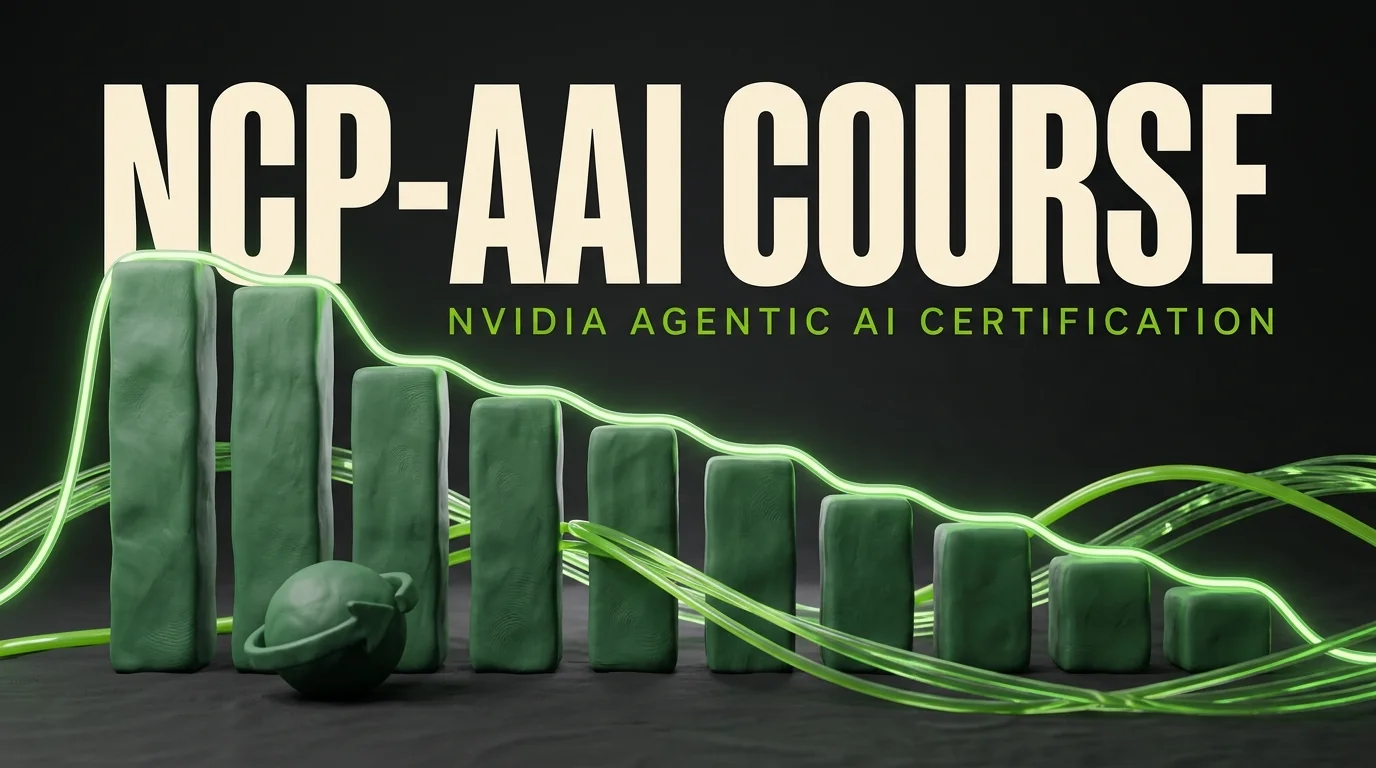
What does the NCP‑AAI course cover?
Every module is one of the 10 exam domains NVIDIA publishes, in exam order, with the domain's share of the exam as its bar. Agent Architecture & Design and Agent Development carry the most at 15% and 15%. The exam runs 120 minutes for 60-70 questions. Open a module for its lessons and labs; the practice tests close the course.
Design agent workflows, choose between single- and multi-agent systems, and orchestrate production agent architectures with LangGraph and the NVIDIA stack.
15% of the exam
Agent Foundations & Workflow Design
What an agent actually is, the agent loop, and how to design an agent's control flow.
- 1.1
What an AI agent actually is
Agent vs chatbot vs fixed workflow · An agent dynamically directs its own tool use · The model + tools + environment loop · Autonomy as a spectrum, not a switch
16 minHigh priority
- 1.2
The agent loop: perceive, reason, act, observe
The four-step agent loop · Environment feedback closes the loop · Stopping conditions and step budgets · Where reasoning happens each turn
16 minHigh priority
- 1.3
Designing an agent workflow
Task decomposition · Prompt chaining, routing, parallelization · Orchestrator-workers and evaluator-optimizer · Choosing control flow before code
16 minHigh priority
- 1.4
Workflows vs autonomous agents
Predefined paths vs model-directed control · Cost, latency, and predictability trade-offs · Start simple, add autonomy only when it pays · Failure surface grows with autonomy
14 minCore topic
Multi-Agent Coordination Patterns
When to use multiple agents and the patterns that coordinate them.
- 1.5
Why and when to go multi-agent
Single-agent limits: tool sprawl, context bloat · Separation of concerns across agents · When multi-agent adds cost without benefit · Context isolation as the core driver
15 minHigh priority
- 1.6
The supervisor / orchestrator-worker pattern
A supervisor routes to specialist workers · Workers report back to the supervisor · Central control and observability · Orchestrator-workers for dynamic subtasks
17 minHigh priority
- 1.7
Network, hierarchical, and handoff patterns
Peer-to-peer network coordination · Hierarchical teams of teams · Handoffs via Command and goto · Choosing topology by coupling
16 minCore topic
- 1.8
Shared state, memory, and message passing
Shared graph state vs private scratchpads · Message passing between agents · State reducers and update conflicts · What each agent should and shouldn't see
16 minCore topic
System Architecture & Orchestration
Assemble a production agent system and orchestrate it as a graph.
- 1.9
Anatomy of a production agent system
Model, tools, memory, orchestration, guardrails · Where each component lives · Serving models as microservices · The control plane vs the data plane
16 minHigh priority
- 1.10
Orchestration with LangGraph
StateGraph, nodes, and edges · Shared state and reducers · Compile and invoke lifecycle · Checkpointers and persistence
18 minHigh priority
- 1.11
Routing and conditional control flow
Conditional edges and routers · Cycles and loop termination · Deterministic vs model-decided routing · Guarding against infinite loops
15 minCore topic
- 1.12
Trade-offs, failure modes, and the NVIDIA stack
Latency, cost, and reliability trade-offs · Common agent failure modes · Where NIM, NeMo Retriever, and Guardrails fit · Designing for graceful degradation
17 minHigh priority
Hands-on labs for this domain
Hosted environments, included with Pro.
- Build Two Agents That Talk via the A2A ProtocolHands-on lab · Advanced · 40 min · 6 stepsPro
- Build an AI Agent 3 Ways: ReAct vs Tool Calling vs Plan-and-ExecuteHands-on lab · Intermediate · 35 min · 6 stepsPro
- Build an MCP Tool Server & Connect a LangChain AgentHands-on lab · Advanced · 40 min · 6 stepsPro
- Build a Multi-Agent Supervisor with LangGraphHands-on lab · Intermediate · 40 min · 6 stepsPro
- Build a ReAct Agent with NVIDIA NIMHands-on lab · Intermediate · 35 min · 8 stepsPro
Build agents: tool integration, multimodal capabilities, and prompt engineering for reliable agent behavior.
15% of the exam
Building AI agents
From a single model call to a working, tool-using agent.
- 2.1
From a model call to a working agent
The minimal agent: model + tools + loop · Wiring the loop yourself · Where each part lives · Smallest thing that works
16 minHigh priority
- 2.2
The reason-act tool cycle in code
Model proposes a tool call · Runtime executes it · Result returns as an observation · Loop until a final answer
16 minHigh priority
- 2.3
Agent capabilities and their limits
What tools unlock · Failure modes: wrong tool, bad args, loops · Bounded autonomy · When the agent should defer
16 minCore topic
- 2.4
Prebuilt agents vs building from scratch
create_react_agent prebuilt · When to drop to a custom graph · NeMo Agent Toolkit · Control vs convenience
16 minCore topic
Tool integration
Defining, calling, validating, and designing tools an agent can use reliably.
- 2.5
Defining a tool: schema and description
Name, description, parameter schema · The description is a prompt · Typed parameters · What makes a tool discoverable
16 minHigh priority
- 2.6
The tool-calling protocol end to end
Model emits a structured tool call · Your code runs it · Result returns as a tool message · Multiple and parallel tool calls
16 minHigh priority
- 2.7
Validating inputs and handling tool errors
Validate args before executing · Return errors the model can recover from · Timeouts and retries · Never trust model-supplied args
16 minHigh priority
- 2.8
Tool design patterns
Granularity and idempotency · Return useful, model-readable results · Side-effecting vs read-only tools · Keeping the tool list short
16 minCore topic
Multimodal development
Agents that reason over text, image, and audio.
- 2.9
Multimodal agents: text, image, audio
Mixed-modality inputs · Vision-language models · When modality changes the design · Cost of large inputs
16 minCore topic
- 2.10
Vision-language tool use and grounding
Grounding answers in pixels · Image-aware tool calls · Document and chart understanding · Verifying visual claims
16 minSupporting
Prompt engineering for agents
Prompts and instructions that drive reliable tool use.
- 2.11
Prompting for reliable tool use
Tell the agent when to use which tool · Constrain and guide tool choice · Handle no-tool-needed · Reduce wrong-tool calls
16 minHigh priority
- 2.12
System prompts, instructions, and few-shot
Role and standing instructions · Few-shot tool-call examples · Keeping the system prompt stable · Prompt as a contract
16 minCore topic
Hands-on labs for this domain
Hosted environments, included with Pro.
Benchmark agent performance, optimize systems, and build testing and continuous-improvement loops.
13% of the exam
Performance benchmarking
Measuring agent quality.
- 3.1
Why evaluating agents is hard
Open-ended output and a grader that is itself a model · Non-determinism means one run is not a measurement · The path is part of the behavior
16 minHigh priority
- 3.2
What to measure: success, trajectory, cost, latency
Measuring each of the four signals · Grading success when every run is different
16 minHigh priority
- 3.3
Benchmarks and offline eval sets
Benchmarks: comparing systems on a shared task set · Offline eval sets: the curated dataset you gate change with
16 minHigh priority
- 3.4
LLM-as-judge evaluation
The judge is itself a system you must evaluate · Trajectory, and why one run is not a measurement
16 minHigh priority
System optimization
Tuning for speed and cost.
- 3.5
Optimizing for latency and cost
Latency: what the user actually waits for · Cost: the model tier is the biggest lever · Tuning is measure, change the cheapest safe thing, re-measure
16 minHigh priority
- 3.6
Prompt and tool optimization loops
What you measure, and the signals that drive the loop · Reading a failure, then changing one thing
16 minHigh priority
Testing strategies
Testing non-deterministic systems.
- 3.7
Testing non-deterministic systems
Run it many times: pass@k and pass^k · What you measure: final answer and trajectory · Grading the output: LLM-as-judge
16 minHigh priority
- 3.8
Regression and eval-driven development
The data flywheel: where eval datasets come from · EDD in the dev loop: smoke tests gate commits, full evals gate releases · What a regression test measures: four dimensions at once · How LangSmith frames offline evaluation
16 minHigh priority
Continuous improvement
Closing the eval-to-fix loop.
- 3.9
From traces to fixes
Reading a trajectory to find the failing step · Classifying the failure so the fix matches it · Turning the fix into a regression test
16 minHigh priority
- 3.10
Continuous improvement in production
The data flywheel · Measuring reliability across many runs, not one · What to measure, and how often
16 minHigh priority
Hands-on labs for this domain
Hosted environments, included with Pro.
- Evaluate an Agent with LLM-as-JudgeHands-on lab · Intermediate · 30 min · 5 stepsPro
- LLM Observability: Trace, Cost and Debug a RAG AssistantHands-on lab · Intermediate · 75 min · 8 stepsPro
- Evaluate an AI Agent: Trajectories, Tool Calls and an LLM JudgeHands-on lab · Intermediate · 80 min · 8 stepsPro
- Prompt Regression Testing in CI: A Golden Set That Blocks Bad Prompt ChangesHands-on lab · Intermediate · 50 min · 5 stepsPro
- Planner-Executor Agents with Self-Critique: Plans, Validators, Replanning and Stopping RulesHands-on lab · Intermediate · 60 min · 5 stepsPro
- Optimise Prompts with DSPy: Signatures, Metrics, Few-Shot Compilers and Held-Out TestsHands-on lab · Intermediate · 60 min · 5 stepsPro
Take agents to production: deployment patterns, scaling, and infrastructure considerations.
13% of the exam
Production deployment
Shipping agents reliably.
- 4.1
From notebook to deployed service
The four shifts in order · Servable is a stacked ladder
16 minHigh priority
- 4.2
Serving agents: API surface and state
The API surface: calling a model through OpenAI-compatible NIM · State: making a served agent remember
16 minHigh priority
- 4.3
Durable execution and checkpointing
Checkpoints, threadid, and resume · Choosing a backend for your deployment
16 minHigh priority
System scaling
Concurrency and throughput.
- 4.4
Scaling: concurrency and throughput
Batching: how one GPU serves a crowd at once · Throughput versus latency, measured at the tail · Scale out on the right GPU signal
16 minHigh priority
- 4.5
Long-running and async agent runs
Durable execution with a threadid and a checkpointer · Dispatching the run async so the caller does not block
16 minHigh priority
- 4.6
Cost control at scale
Route cheap by default, escalate only the hard requests · Make each GPU-second cheaper to serve · Defer the work that does not need to be live
16 minHigh priority
Infrastructure considerations
GPUs, microservices, and serving.
- 4.7
Infrastructure: GPUs and NIM microservices
What the GPU layer underneath actually does · Wiring NIM into a durable agent
16 minHigh priority
- 4.8
Self-hosted vs hosted model endpoints
The tradeoff: speed-to-ship against control and unit cost · What you actually operate when you self-host
16 minHigh priority
Hands-on labs for this domain
Hosted environments, included with Pro.
Reasoning patterns (ReAct, CoT, ToT), planning strategies, and memory and state management.
10% of the exam
Reasoning patterns (ReAct, ToT, CoT)
How agents reason before acting.
- 5.1
Chain-of-thought reasoning
Three ways to elicit a chain of thought · Self-Consistency: vote across several traces
16 minCore topic
- 5.2
ReAct: reasoning plus acting
The Thought, Action, Observation cycle · When ReAct is the right paradigm · Implementing ReAct as an agent
16 minCore topic
- 5.3
Tree-of-thoughts and deliberate search
The four components of a thought search · The cost trade-off and when to reach for it
16 minCore topic
Planning strategies
Plan-and-execute and re-planning.
- 5.4
Plan-and-execute agents
Eager planning versus lazy planning · The research lineage: Plan-and-Solve and ReWOO · Building it in LangGraph
16 minCore topic
- 5.5
Reflection and re-planning
Reflexion: learning from feedback in words · Self-critique at the single-task level · Re-planning: revising the plan when evidence diverges
16 minCore topic
Memory management
Short- and long-term memory.
- 5.6
Short-term vs long-term memory
Short-term memory is the context window · Long-term memory is persistent external storage
16 minCore topic
- 5.7
Memory stores and retrieval
The store types and what each one keeps · Where long-term memory lives and how retrieval scales · Wiring memory into an agent
16 minCore topic
State management
Tracking state across turns.
- 5.8
State management across turns
How a turn updates the shared state · Where state lives across turns, and making it persist
16 minCore topic
- 5.9
Context-window management
Budgeting tokens and prioritizing what stays · Compaction for long-horizon agent runs
16 minCore topic
Hands-on labs for this domain
Hosted environments, included with Pro.
RAG pipelines, retrieval mechanisms, embeddings, and semantic search for agents.
10% of the exam
RAG pipelines
Retrieval-augmented generation end to end.
- 6.1
RAG fundamentals: why retrieve
Why retrieve instead of stuffing or retraining
16 minCore topic
- 6.2
The RAG pipeline end to end
The indexing phase: build the database once · The querying phase: retrieve, rerank, generate · Debugging by stage when the answer is wrong
16 minCore topic
- 6.3
Agentic RAG: retrieval as a tool
Two RAG patterns, side by side · Wiring it in LangGraph · Retrieval as a tool beyond LangGraph
16 minCore topic
Retrieval mechanisms
Search, rerank, and NeMo Retriever.
- 6.4
Keyword, vector, and hybrid retrieval
Keyword retrieval: exact term overlap with BM25 · Vector retrieval: similarity over meaning · Hybrid retrieval: run both, then fuse the rankings
16 minCore topic
- 6.5
Reranking and NeMo Retriever
Two stages: retrieve fast, then rerank for relevance · NeMo Retriever: the four-stage document pipeline
16 minCore topic
Embeddings & semantic search
Vectors as meaning.
- 6.6
Embeddings: vectors as meaning
Measuring closeness: cosine similarity and the matmul trick · Asymmetric models and the rules that keep vectors compatible
16 minCore topic
- 6.7
Semantic search and vector stores
From words to vectors: how semantic search works · Vector stores: indexing embeddings for fast k-NN · Worked example: a 50,000-chunk support knowledge base
16 minCore topic
Data processing
Chunking, parsing, and pipelines.
- 6.8
Chunking and data preparation
How a recursive splitter cuts on natural boundaries · Sizing chunks, and the tradeoff the exam tests
16 minCore topic
- 6.9
Document and multimodal ingestion
From raw source to clean, chunkable text · Multimodal ingestion: making images retrievable
16 minCore topic
Hands-on labs for this domain
Hosted environments, included with Pro.
- Build a RAG Pipeline with NVIDIA NIMHands-on lab · Intermediate · 35 min · 7 stepsFree
- Multimodal RAG with NeMo RetrieverHands-on lab · Intermediate · 35 min · 4 stepsPro
- Evaluate a RAG Pipeline: Retrieval Metrics, Faithfulness and a Regression GateHands-on lab · Intermediate · 80 min · 8 stepsPro
- RAG Chunking Shoot-Out: Measure Which Chunking Strategy RetrievesHands-on lab · Intermediate · 50 min · 5 stepsPro
- Hybrid Search and Reranking: BM25, Embeddings, RRF and an LLM RerankerHands-on lab · Intermediate · 55 min · 5 stepsPro
- Query Rewriting and HyDE: Better Queries for the Search You HaveHands-on lab · Intermediate · 50 min · 4 stepsPro
- Document AI: Turn PDFs, Tables and Scans into Clean RAG ChunksHands-on lab · Intermediate · 55 min · 5 stepsPro
- Vector Index Internals: Exact Search, IVF, HNSW, Product Quantization and Filtered Search with FAISSHands-on lab · Intermediate · 55 min · 5 stepsPro
- Long Context vs RAG: Accuracy, Cost and Latency on the Same 24 QuestionsHands-on lab · Intermediate · 55 min · 5 stepsPro
Implement agents on the NVIDIA stack: NIM microservices, NeMo Retriever, AI Foundation endpoints, and Nemotron models.
7% of the exam
NIM microservices
Serving models as microservices.
- 7.1
NVIDIA NIM: models as microservices
The endpoint is decoupled and shared · What runs behind the endpoint
16 minSupporting
- 7.2
Deploying and calling NIM endpoints
Calling a hosted NIM endpoint · Tool calling and the ReAct loop on NIM · Deploying a NIM: hosted or self-hosted
16 minSupporting
NeMo Retriever
Enterprise retrieval microservices.
- 7.3
NeMo Retriever for enterprise RAG
The four stages, and why each is a separate microservice · Reranking and hybrid search: trading latency for precision
16 minSupporting
AI Foundation endpoints
Hosted model endpoints on build.nvidia.com.
- 7.4
AI Foundation endpoints and the NVIDIA API Catalog
What the catalog hosts and how you find it · Why the deployment target comes down to billing rather than the API · Getting access: the key, the free tier, and the worked path
16 minSupporting
- 7.5
NeMo Agent Toolkit on the NVIDIA stack
Built-in agents and components · Distributed tools, observability, and the NeMo workflow
16 minSupporting
Nemotron models
NVIDIA's open model family.
- 7.6
The Nemotron model family
Three members, one architecture · Reaching Nemotron from your agent
16 minSupporting
- 7.7
Choosing NVIDIA models for agents
Read the function-calling benchmark before you commit · Serving and economics are separate decisions from the model · Justify the pick with measured quality
16 minSupporting
Hands-on labs for this domain
Hosted environments, included with Pro.
- Build an MCP Tool Server & Connect a LangChain AgentHands-on lab · Advanced · 40 min · 6 stepsPro
- Build a RAG Pipeline with NVIDIA NIMHands-on lab · Intermediate · 35 min · 7 stepsFree
- Build a ReAct Agent with NVIDIA NIMHands-on lab · Intermediate · 35 min · 8 stepsPro
- Evaluate an Agent with LLM-as-JudgeHands-on lab · Intermediate · 30 min · 5 stepsPro
Operate live agent systems: monitoring, observability, troubleshooting, and continuous operations.
5% of the exam
System monitoring
Metrics that matter for agents.
- 8.1
What to monitor in agent systems
Quality signals versus operational guardrails · Latency, errors, and drift
16 minSupporting
- 8.2
Metrics, logs, and dashboards
Building the agent dashboard · Cost as a first-class signal · Where the dashboards come from
16 minSupporting
Observability
Tracing agent runs.
- 8.3
Observability and tracing with LangSmith
Instrumenting an agent with the LangSmith SDK · How the telemetry is organized · Choosing where LangSmith runs
16 minSupporting
- 8.4
Tracing agent trajectories
Spans: the unit a trajectory is built from · Why graph and ReAct agents are natively traceable
16 minSupporting
Troubleshooting
Diagnosing agent failures.
- 8.5
Troubleshooting agent failures
The five error types, each with its own recovery · Chain and trace debugging: making a run inspectable · Diagnosing RAG failures with RAGAS, and what tooling automates
16 minSupporting
- 8.6
Maintenance and continuous operations
What causes drift, and what prevents it · Version control, traceability, and rollback · Continuous evaluation and the operations lifecycle
16 minSupporting
Hands-on labs for this domain
Hosted environments, included with Pro.
Guardrails, NeMo Guardrails implementation, responsible AI, and compliance for agent systems.
5% of the exam
AI guardrails
Bounding what agents can do.
- 9.1
Why agents need guardrails
Guardrails sit outside the agent · Defense in depth and the kinds of constraints
16 minSupporting
- 9.2
Input, output, and action guardrails
Input rails: clean the message before the model reads it · Output rails: check the answer before the user sees it · Action (Execution) rails: govern what the agent does
16 minSupporting
NeMo Guardrails implementation
Programmable rails in practice.
- 9.3
NeMo Guardrails and Colang
The two-file config and writing policy in Colang · Wiring it up in Python and adding an LLM safety rail · Colang 1.0 today and the 2.0 overhaul
16 minSupporting
- 9.4
The five rail types in practice
Five rails, arranged as defense in depth · Safety rails, topical rails, and the NIM classifiers behind them · Worked example: wiring rails around an agent
16 minSupporting
Responsible AI & compliance
Practices and requirements.
- 9.5
Responsible AI practices
Seven principles, each with a control that enforces it · How the model itself is made safer: Constitutional AI and harmlessness screens · Human oversight, audit trails, and governance at frontier scale
16 minSupporting
- 9.6
Compliance and auditability
Policy-as-code: put the rules where the model cannot touch them · Compliance by design: what GDPR and the EU AI Act change in the agent
16 minSupporting
Hands-on labs for this domain
Hosted environments, included with Pro.
Human-in-the-loop design, oversight mechanisms, and interaction patterns for agent systems.
5% of the exam
Human-in-the-loop design
Approvals, interrupts, and review.
- 10.1
Human-in-the-loop: approvals and interrupts
Two gates, and an autonomy dial · How an interrupt pauses and resumes the graph · Why compliance rules live in tool code
16 minSupporting
- 10.2
Implementing HITL with LangGraph interrupts
Describing the choice: HumanInterrupt and its four options · Where the paused state lives: checkpointers · Tool-level interrupts, parallel resumes, and the client loop
16 minSupporting
Oversight mechanisms
Keeping humans in control.
- 10.3
Oversight mechanisms and escalation
Triggers that work and triggers that lie · Tiered routing, SLAs, and auditability
16 minSupporting
- 10.4
Keeping humans in control
Interruptibility and graceful recovery · Human-in-the-loop gates: approval, review, and the resume path · Accountability and sandboxing
16 minSupporting
User interaction patterns
UX for agent systems.
- 10.5
UX patterns for agent systems
Streaming is the load-bearing pattern · Shared control: co-active workflows and multimodal confirmation
16 minSupporting
- 10.6
Trust, transparency, and feedback
Transparency, explainability, and calibrated confidence · Feedback, the human edit, and the audit trail
16 minSupporting
Hands-on labs for this domain
Hosted environments, included with Pro.
Each test mirrors the real exam: 120 minutes, 75 questions, all domains in proportion. Learning mode shows the explanation after each answer; exam mode runs the clock and scores at the end. The study plan below schedules them across the weeks.
- 1
Practice test 1
Covering all NCP-AAI exam domains including Agent Architecture, RAG Pipelines, NVIDIA NIM, and NeMo Safety.
75 questions · 120 min
- 2
Practice test 2
Covering advanced topics in Agentic AI for NCP-AAI exam including Multi-Agent Orchestration, Security, and Performance Optimization.
75 questions · 120 min
- 3
Practice test 3
Focusing on production deployment, maintenance, monitoring, and troubleshooting of Agentic AI systems.
75 questions · 120 min
- 4
Practice test 4
Covering real-world case studies, advanced reasoning, ethics, and comprehensive system design scenarios.
75 questions · 120 min
- 5
Practice test 5
Emphasizing MLOps, testing methodologies, evaluation metrics, and reliability engineering for agentic systems.
75 questions · 120 min
- 6
Practice test 6
Covering latency optimization, multimodal integration, advanced architecture, and system robustness.
75 questions · 120 min
- 7
Practice test 7
Focusing on comprehensive scenario-based questions covering all domains.
76 questions · 120 min
Try 15 free questions on the certificate page before you buy.
What does a lesson look like?
Lesson 1.1, played through: read the concept, toggle the widget, pass the checkpoint, and the next lesson is queued. Every lesson in the course runs this way; 232 widgets and 170 checkpoints in all.
1.1What an AI agent actually is16 min
On this page
- Agent, chatbot, and workflow are three different things
- Why the distinction matters for the exam and in production
Picture a support system that has to refund a customer. A scripted bot follows a fixed path: read the message, look up the order, check the refund policy, reply.
Now picture the same task handed to something that is given a set of tools and a goal, and left to work out the steps itself.
Same task. The second system chose its own path. That choice is what makes it an agent.
How long does it take to prepare with this course?
About 23 hours of lessons, 85 of them at roughly 16 minutes each. With the 7 practice tests and review, plan on about 48 hours. The modules run in exam order, so the heaviest domains come first. Pick a pace and the plan lays itself out.
- Week 1Agent Architecture & Design3h 12m of lessons3h 12m
- Week 2Agent DevelopmentPractice test 13h 12m of lessons3h 12m
- Week 3Evaluation & TuningPractice test 22h 40m of lessons2h 40m
- Week 4Deployment & ScalingPractice test 32h 8m of lessons2h 8m
- Week 5Cognition, Planning & MemoryPractice test 42h 24m of lessons2h 24m
- Week 6Knowledge Integration & Data Handling · NVIDIA Platform ImplementationPractice test 54h 16m of lessons4h 16m
- Week 7Run, Monitor & MaintainPractice test 61h 36m of lessons1h 36m
- Week 8Safety, Ethics & Compliance · Human-AI Interaction & OversightPractice test 7 · Schedule the exam once you clear 75% on a fresh test3h 12m of lessons3h 12m
Where do I practise hands-on?
31 labs in hosted environments, each opening in the browser with the setup done. They cover the patterns the exam asks about in scenario form: multi-agent supervisors, tool servers, RAG on NIM, guardrails, evaluation. Every module above lists the labs for its domain. Labs come with Pro.
Hands-on
Labs· 31
Build Two Agents That Talk via the A2A Protocol
UnlockAdd Long-Term Memory to an AI Agent: LangGraph + Milvus
UnlockBuild an AI Agent 3 Ways: ReAct vs Tool Calling vs Plan-and-Execute
UnlockBuild an MCP Tool Server & Connect a LangChain Agent
UnlockBuild a Multi-Agent Supervisor with LangGraph
UnlockBuild a RAG Pipeline with NVIDIA NIM
LaunchBuild a ReAct Agent with NVIDIA NIM
UnlockBuild NeMo Guardrails for an AI Agent: Jailbreak & Topical Rails
UnlockEvaluate an Agent with LLM-as-Judge
Unlock Hosted Pro
Model Routing & Cost Cascade with NIM
Unlock Hosted Pro
Structured Output & Function Calling with NIM
Unlock Hosted Pro
Visual Q&A with NVIDIA VLMs
Unlock Hosted Pro
Multimodal RAG with NeMo Retriever
Unlock Hosted Pro
LLM Observability: Trace, Cost and Debug a RAG Assistant
Unlock HostedFree
Build an Agent From Scratch: The Tool Loop Without a Framework
Launch Hosted Pro
Evaluate an AI Agent: Trajectories, Tool Calls and an LLM Judge
Unlock Hosted Pro
Evaluate a RAG Pipeline: Retrieval Metrics, Faithfulness and a Regression Gate
Unlock Hosted Pro
RAG Chunking Shoot-Out: Measure Which Chunking Strategy Retrieves
Unlock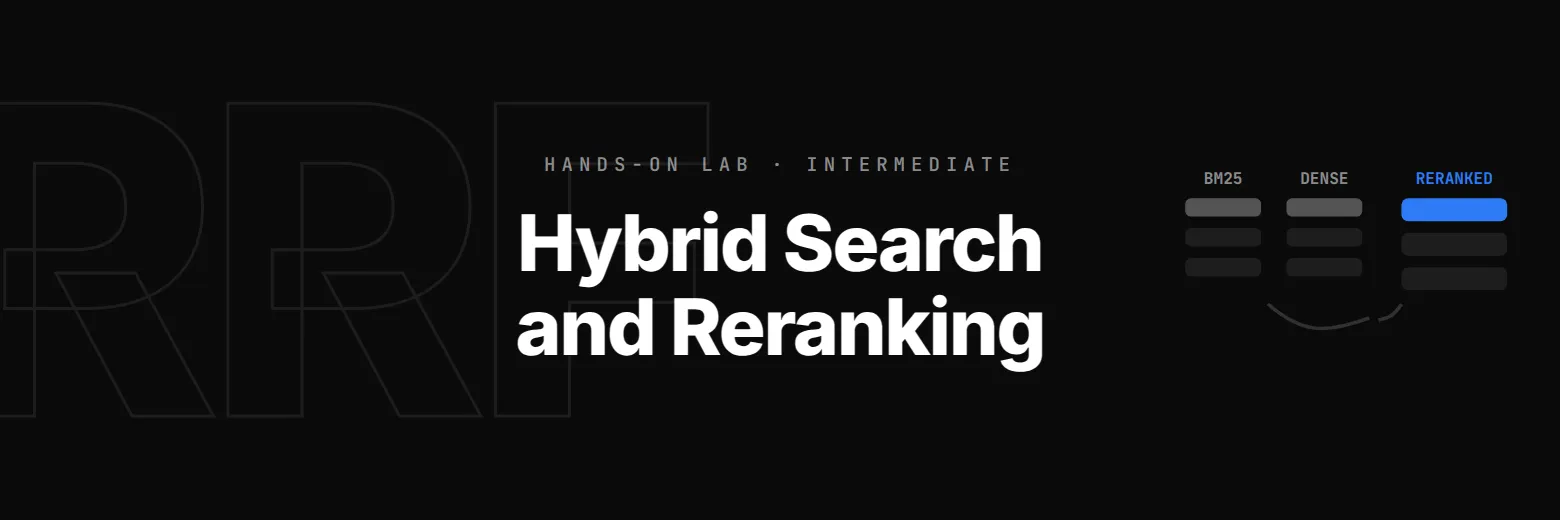 Hosted Pro
Hybrid Search and Reranking: BM25, Embeddings, RRF and an LLM Reranker
Unlock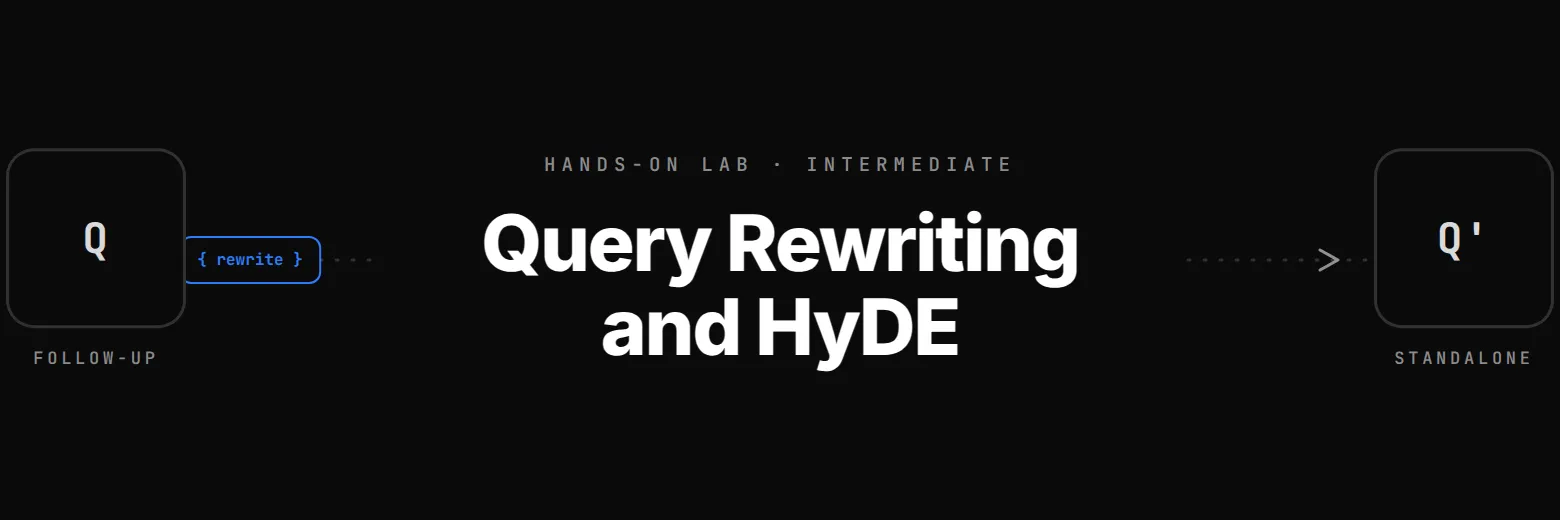 Hosted Pro
Query Rewriting and HyDE: Better Queries for the Search You Have
Unlock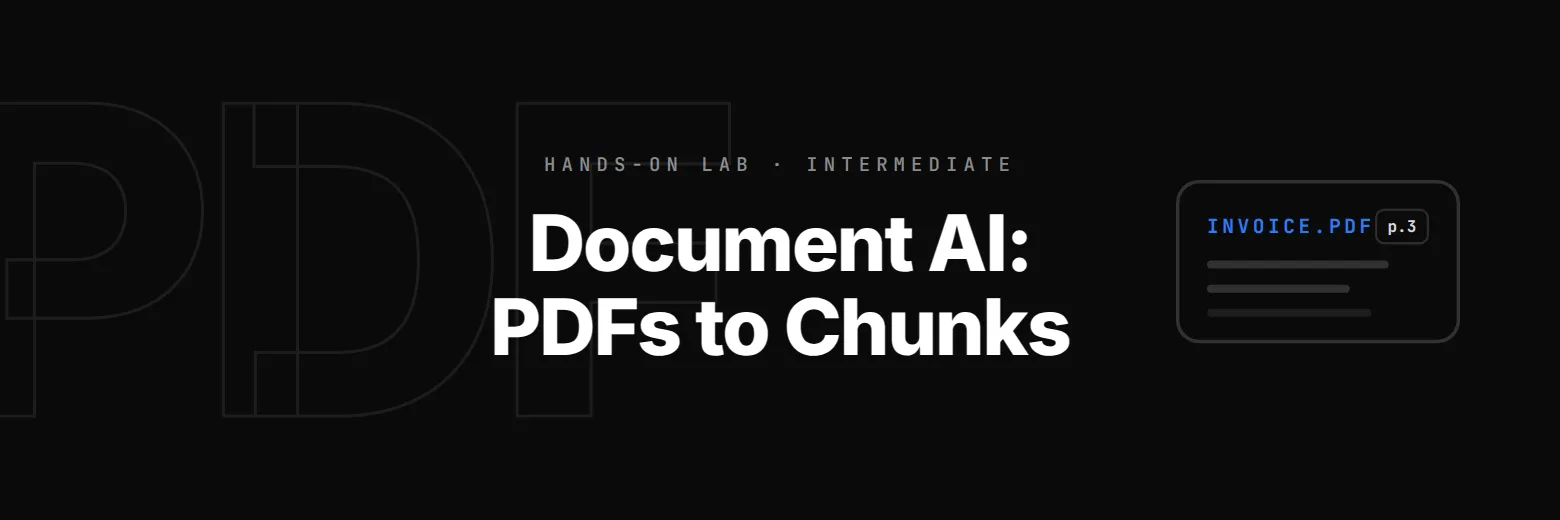 Hosted Pro
Document AI: Turn PDFs, Tables and Scans into Clean RAG Chunks
Unlock Hosted Pro
Context Engineering: Token Budgets, Compaction and Running Notes for Long Chats
Unlock Hosted Pro
Web Research Agent: Search, Read and Cite Without Being Fooled by the Web
Unlock Hosted Pro
Code-Executing Data Agent: Let an LLM Answer Questions With pandas, Safely
Unlock Hosted Pro
Prompt Regression Testing in CI: A Golden Set That Blocks Bad Prompt Changes
Unlock Hosted Pro
Vector Index Internals: Exact Search, IVF, HNSW, Product Quantization and Filtered Search with FAISS
Unlock Hosted Pro
Long Context vs RAG: Accuracy, Cost and Latency on the Same 24 Questions
Unlock Hosted Pro
Build an MCP Client and Host: Handshake, Tool Discovery, Error Handling and Approvals
Unlock Hosted Pro
Human-in-the-Loop Agent: Approval Interrupts, Durable Pauses, Crash-Safe Tools and Escalation
Unlock Hosted Pro
Planner-Executor Agents with Self-Critique: Plans, Validators, Replanning and Stopping Rules
Unlock Hosted Pro
Optimise Prompts with DSPy: Signatures, Metrics, Few-Shot Compilers and Held-Out Tests
UnlockIs it enough to pass?
The NCP-AAI is challenging because it tests cutting-edge agentic AI concepts that many AI engineers haven't used in production.
Deployment & Scaling (13%) and Safety & Ethics (5%) are often neglected but critical. Many engineers focus on agent development but fail questions about production deployment, monitoring, and implementing guardrails. Those domains have their own modules here, with the same weight the exam gives them.
- 511
- 46
- 34
- 20
- 10
Just passed the exam today
The practice test look cover all part and similar format like real exam. I propose add some multi correct answer question
Verified purchase · Dec 2025
Decent overall
Criticisms: - Most questions have easily discardable choices - Some questions are clearly similar variations of each other - Some questions are too simple imo
Verified purchase · Jun 2026
Ready to start the NCP-AAI course?
The course and the practice tests come together in one purchase, or go Pro to add 31 hands-on labs for this cert plus every other track on Preporato.
Course + practice tests
Lifetime access: pay once, study forever
Plus tax where applicable
- 85 interactive lessons with checkpoints
- 7 full-length practice tests
- 526+ exam-style questions
- Detailed explanations for every answer
- Exam mode & learning mode
- ×No hands-on labs
First-Attempt Pass Guarantee
Finish all 7 practice exams and score 80% or more on your first try at two of them. If you then fail the real NCP-AAI exam, we refund your purchase. How it works
Preporato Pro
Billed monthly, cancel anytime
Plus tax where applicable
- 31 hands-on labs for NCP-AAI + 147 more AI/ML labs
- Every course and practice test across every certification
- GPU sandboxes and hosted environments
- Flashcards, study guides and articles
- Cancel anytime, no contract
from$19.99course + tests