

TL;DR: The AWS SAA-C03 exam has 4 domains: Security (30%), Resilience (26%), Performance (24%), and Cost (20%). Security is the heaviest domain and most common failure point. Focus 35% of study time on Domain 1, master VPC networking and IAM policies, and complete 4+ practice exams for best results.
The AWS Certified Solutions Architect Associate (SAA-C03) exam tests your ability to design solutions using the AWS Well-Architected Framework. Understanding the exact weight and scope of each domain is critical for efficient exam preparation.
Exam Quick Facts
Why Domain Weights Matter
AWS uses a compensatory scoring model, you don't need to pass each domain individually, but you must pass overall. However, failing badly in the 30% Security domain is nearly impossible to recover from. Strategic study allocation based on domain weights dramatically improves pass rates. Ready to test yourself? Preporato's SAA-C03 practice tests include 6 full-length exams with an explanation for every option, and the free SAA-C03 sample questions lets you try 20 questions first.
SAA-C03 Domain Weight Overview
The SAA-C03 exam covers four domains, each testing different aspects of AWS solution design:
| Domain | Weight | Questions* | Focus Area |
|---|---|---|---|
| Domain 1: Design Secure Architectures | 30% | ~19-20 | IAM, VPC Security, Encryption, Compliance |
| Domain 2: Design Resilient Architectures | 26% | ~16-17 | High Availability, DR, Fault Tolerance |
| Domain 3: Design High-Performing Architectures | 24% | ~15-16 | Compute, Storage, Database, Caching |
| Domain 4: Design Cost-Optimized Architectures | 20% | ~12-13 | Pricing Models, Right-sizing, Optimization |
*Based on 50 scored questions. The exam includes 15 additional unscored questions distributed randomly.
Recommended Study Time Allocation
Optimal study time distribution based on domain weights:
- Domain 1 (Security): 35% of study time. Heaviest weight and most complex topics.
- Domain 2 (Resilience): 25% of study time. Critical for real-world architecture.
- Domain 3 (Performance): 25% of study time. Requires hands-on experience.
- Domain 4 (Cost): 15% of study time. Most intuitive once you understand the other domains.
Go deeper on each domain
Each domain below has a dedicated deep-dive: IAM & security and VPC networking for Security; high availability & DR and SQS/SNS/EventBridge for Resilience; S3 storage classes and databases for Performance; cost optimization for Cost. Then follow the 8-week study plan.
Try 15 SAA-C03 practice questions free
They come from the SAA-C03 practice tests, and each option shows its explanation once you answer.
- 6 timed practice exams
- Every answer explained
- A score for each domain
- $19.99 one-time
Domain 1: Design Secure Architectures (30%)
This is the most heavily weighted domain and the #1 reason candidates fail. Security increased from 24% (SAA-C02) to 30% (SAA-C03), reflecting AWS's emphasis on secure-by-design architectures.
Core Topics
- •AWS IAM: Users, Groups, Roles, Policies, Permission Boundaries
- •Identity Federation: SAML 2.0, Web Identity, AWS SSO, Cognito
- •VPC Security: Security Groups, NACLs, VPC Endpoints, PrivateLink
- •Network Security: AWS WAF, Shield, Network Firewall, Firewall Manager
- •Encryption: KMS (CMK, AWS-managed), CloudHSM, ACM, S3 encryption
- •Secrets Management: Secrets Manager vs. Parameter Store
- •Monitoring & Detection: GuardDuty, Security Hub, Inspector, Macie
- •Cross-Account Access: Resource-based policies, STS AssumeRole
- •Compliance: AWS Artifact, Config Rules, CloudTrail
Skills Tested
Example Question Topics
- A company needs to grant a third-party auditor read-only access to specific S3 buckets. What is the MOST secure approach?
- An application in a private subnet needs to access DynamoDB without traversing the internet. Which solution should the architect recommend?
- How should sensitive database credentials be stored and rotated automatically for an application running on EC2?
Domain 1 Key Services to Master
| Service | Why It's Tested | Common Scenarios |
|---|---|---|
| IAM | Foundation of all AWS security | Cross-account access, least privilege, service roles |
| VPC | Network isolation and security | Private/public subnets, NACLs vs SGs, VPC endpoints |
| KMS | Encryption key management | CMK rotation, cross-region keys, key policies |
| Secrets Manager | Credential management | RDS credential rotation, Lambda integration |
| GuardDuty | Threat detection | Compromised credentials, crypto mining detection |
| WAF | Application layer protection | SQL injection, XSS, rate limiting |
Security Groups vs NACLs: Critical Comparison
Security Groups vs Network ACLs
| Feature | Security Groups | Network ACLs |
|---|---|---|
| Scope | Instance level | Subnet level |
| State | Stateful (return traffic auto-allowed) | Stateless (must allow both directions) |
| Rules | Allow rules only | Allow AND Deny rules |
| Evaluation | All rules evaluated | Rules processed in order |
| Default | Denies all inbound, allows all outbound | Allows all traffic |
| Use Case | Primary instance protection | Subnet-level guardrails |
Common Exam Trap
"Block a specific IP address" = Network ACL (Security Groups can't deny) "Allow traffic from another security group" = Security Group (NACLs use CIDR only) "Stateless firewall needed" = Network ACL
IAM Policy Evaluation Logic
Understanding how AWS evaluates IAM policies is tested heavily:
- Explicit Deny → Always wins (policy evaluation stops)
- Organization SCPs → Must allow the action
- Resource-based policies → Can grant cross-account access
- IAM permissions boundaries → Sets maximum permissions
- Session policies → For assumed roles/federated users
- Identity-based policies → User/group/role policies
- Implicit Deny → Default if no explicit allow exists
Exam Strategy: Domain 1
When answering security questions, always consider:
- Least privilege: Never grant more access than needed
- Defense in depth: Multiple security layers
- Encryption everywhere: At rest AND in transit
- Centralized management: Use Organizations, Security Hub, SSO
Domain 2: Design Resilient Architectures (26%)
This domain tests your ability to design systems that survive failures and recover quickly. You must understand Multi-AZ vs Multi-Region patterns, disaster recovery strategies, and loosely coupled architectures.
Disaster Recovery Strategies: RTO/RPO Tradeoffs
| Strategy | RTO | RPO | Cost | Use Case |
|---|---|---|---|---|
| Backup & Restore | Hours | Hours | $ | Non-critical systems, compliance archives |
| Pilot Light | 10-30 min | Minutes | $$ | Core systems kept minimal, scale up on disaster |
| Warm Standby | Minutes | Seconds-Minutes | $$$ | Business-critical with low RTO requirements |
| Active-Active (Multi-Site) | Near-zero | Near-zero | $$$$ | Mission-critical, zero-downtime tolerance |
RTO vs RPO Explained
RPO (Recovery Point Objective): Maximum acceptable data loss measured in time. RPO of 1 hour = you can lose up to 1 hour of data.
RTO (Recovery Time Objective): Maximum acceptable downtime. RTO of 4 hours = system must be operational within 4 hours of failure.
Exam Tip: Lower RTO/RPO = Higher cost and complexity. Always match strategy to business requirements.
Load Balancer Selection Guide
| Load Balancer | Layer | Protocol | Best For |
|---|---|---|---|
| ALB | 7 (Application) | HTTP/HTTPS, gRPC | Web apps, microservices, path-based routing |
| NLB | 4 (Transport) | TCP, UDP, TLS | Ultra-low latency, static IPs, gaming, IoT |
| GLB | 3 (Gateway) | IP | Third-party virtual appliances, firewalls |
| CLB | 4 & 7 | TCP, SSL, HTTP | Legacy (avoid for new architectures) |
Decoupling Patterns
SQS vs SNS vs EventBridge
| Feature | SQS | SNS | EventBridge |
|---|---|---|---|
| Pattern | Queue (pull-based) | Pub/Sub (push-based) | Event Bus (rule-based) |
| Delivery | At-least-once or exactly-once (FIFO) | At-least-once | At-least-once |
| Consumers | Single consumer group | Multiple subscribers | Multiple targets with filtering |
| Use Case | Decouple microservices, buffer requests | Fan-out notifications | Event-driven architectures, SaaS integration |
| Retention | 1-14 days | Immediate (no retention) | 24 hours (archive to S3) |
Domain 3: Design High-Performing Architectures (24%)
This domain tests your ability to select the right service for the right workload. You must understand compute options, storage types, database selection, and caching strategies.
EBS Volume Types: Performance Comparison
| Volume Type | IOPS (max) | Throughput (max) | Use Case |
|---|---|---|---|
| gp3 | 16,000 | 1,000 MiB/s | General purpose, boot volumes, dev/test |
| gp2 | 16,000 | 250 MiB/s | Legacy general purpose (prefer gp3) |
| io2 Block Express | 256,000 | 4,000 MiB/s | Mission-critical databases, SAP HANA |
| io2 | 64,000 | 1,000 MiB/s | High-performance databases |
| st1 | 500 | 500 MiB/s | Big data, data warehouses, log processing |
| sc1 | 250 | 250 MiB/s | Cold data, infrequent access |
EBS Selection Quick Rules
- Need max IOPS? → io2 Block Express (256K IOPS)
- Cost-effective general purpose? → gp3 (cheaper than gp2, higher baseline)
- Sequential large reads? → st1 (throughput optimized)
- Lowest cost archive? → sc1 (cold HDD)
Database Selection Matrix
| Requirement | Best Choice | Why |
|---|---|---|
| Relational + High Availability | Aurora | Multi-AZ by default, 5x throughput of MySQL |
| Key-value at any scale | DynamoDB | Single-digit ms latency, auto-scaling |
| Caching for RDS | ElastiCache Redis | Sub-millisecond reads, persistence options |
| Caching for DynamoDB | DAX | Microsecond latency, seamless integration |
| Document database | DocumentDB | MongoDB-compatible, fully managed |
| Data warehouse (PB scale) | Redshift | Columnar storage, SQL analytics |
| Graph database | Neptune | Relationships and connections |
| Time-series data | Timestream | IoT, metrics, time-based queries |
Caching Strategy Layers
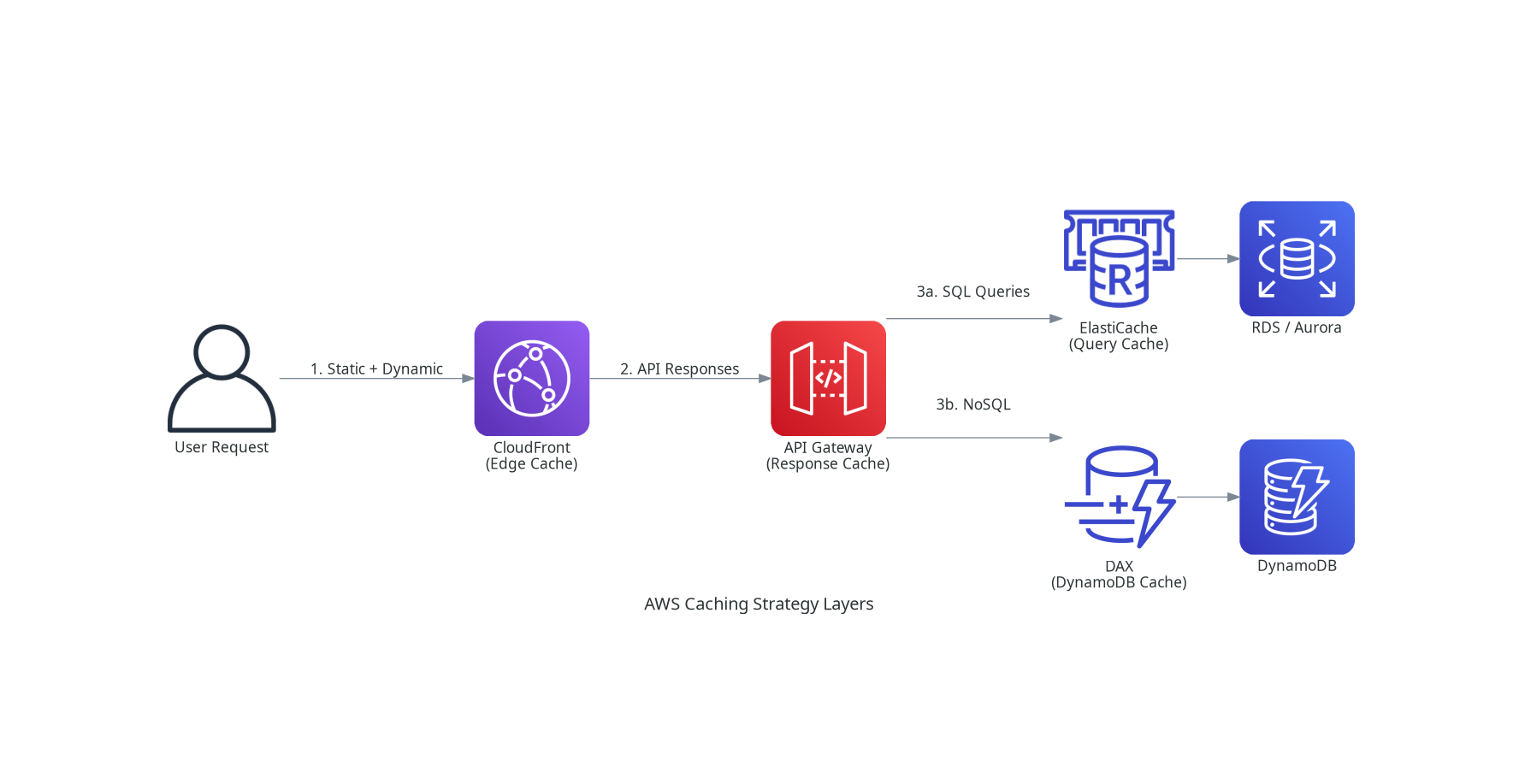
Layer-by-layer breakdown:
- CloudFront (Edge): Caches static assets and dynamic API responses at 400+ edge locations globally
- API Gateway: Caches API responses to reduce backend calls (TTL configurable)
- ElastiCache Redis: Caches database query results for RDS/Aurora workloads
- DAX: In-memory cache specifically for DynamoDB (microsecond latency)
Domain 4: Design Cost-Optimized Architectures (20%)
This domain tests your ability to design solutions that minimize cost while meeting requirements. You must understand pricing models, right-sizing, and cost monitoring tools.
EC2 Purchasing Options Comparison
| Option | Discount | Commitment | Best For |
|---|---|---|---|
| On-Demand | 0% | None | Unpredictable workloads, testing |
| Savings Plans (Compute) | Up to 66% | 1 or 3 years | Flexible across instance families |
| Savings Plans (EC2) | Up to 72% | 1 or 3 years | Specific instance family |
| Reserved Instances | Up to 72% | 1 or 3 years | Steady-state, predictable usage |
| Spot Instances | Up to 90% | None | Fault-tolerant, flexible timing |
| Dedicated Hosts | Varies | None or Reserved | Licensing, compliance requirements |
Savings Plans vs Reserved Instances
Choose Savings Plans when: You want flexibility to change instance types, sizes, OS, or tenancy.
Choose Reserved Instances when: You need capacity reservation in specific AZ, or have legacy billing requirements.
2026 Update: AWS now recommends Savings Plans over RIs for most workloads due to greater flexibility.
S3 Storage Class Decision Tree
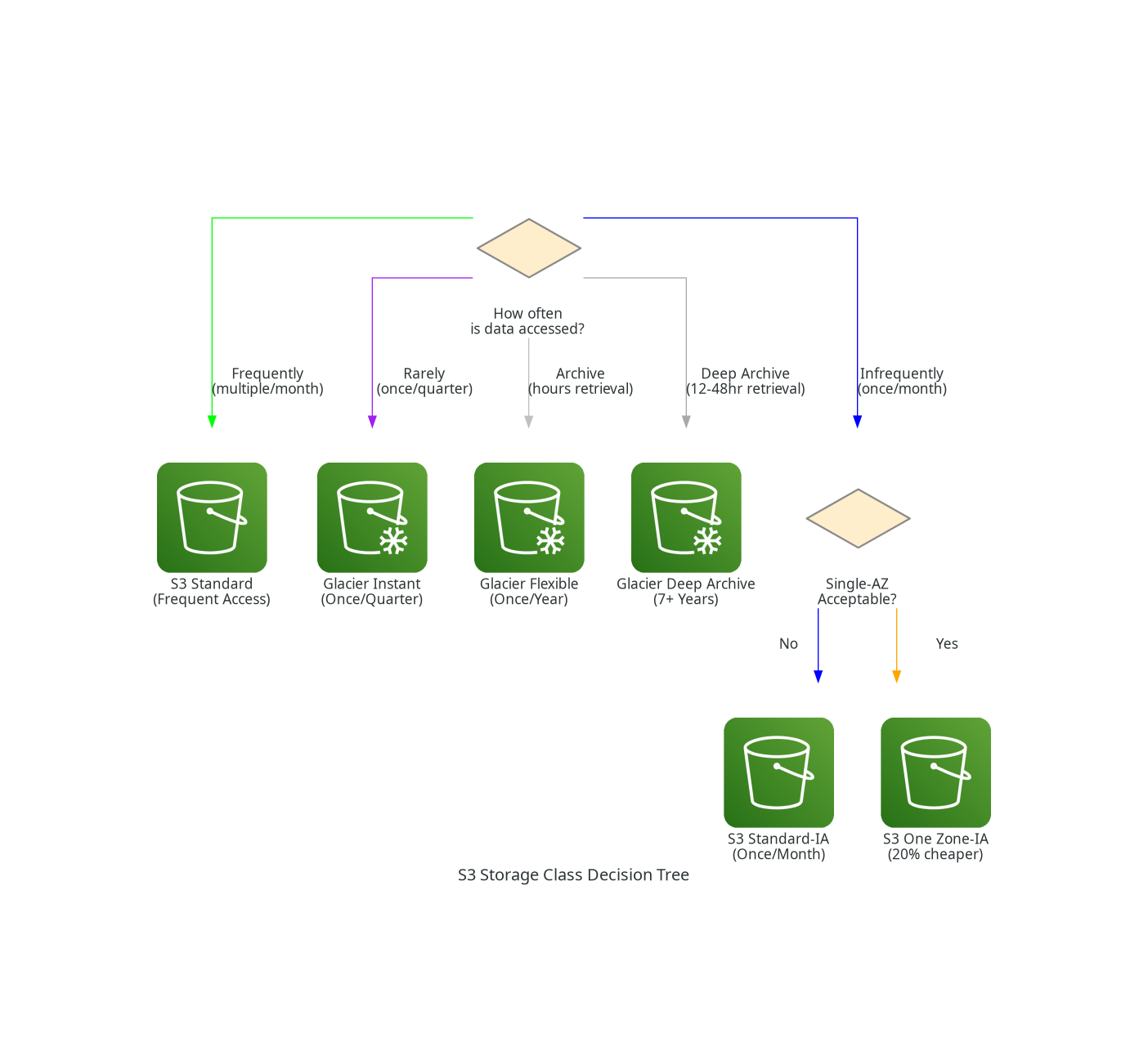
Quick selection guide:
| Access Pattern | Storage Class | Retrieval Time | Cost (relative) |
|---|---|---|---|
| Multiple times/month | S3 Standard | Milliseconds | $$$ |
| Once/month (multi-AZ) | S3 Standard-IA | Milliseconds | $$ |
| Once/month (single-AZ OK) | S3 One Zone-IA | Milliseconds | $ |
| Once/quarter | Glacier Instant | Milliseconds | $ |
| Once/year | Glacier Flexible | Minutes-hours | ¢ |
| Compliance (7+ years) | Glacier Deep Archive | 12-48 hours | ¢ |
Cost Optimization Checklist
SAA-C03 Cost Optimization Topics
0/8 completedThree questions from the SAA-C03 practice tests
An application running on Amazon EC2 instances needs to access an Amazon DynamoDB table in the same Region. The company's security policy prohibits traffic from traversing the public internet. How should the solutions architect configure the network?
A VPC Gateway Endpoint for DynamoDB keeps traffic between the VPC and DynamoDB within the AWS network, avoiding the public internet.
B. Direct Connect is for on-premises to AWS connectivity.
C. NAT gateways allow outbound internet access, but traffic still technically traverses the public internet space (though securely). VPC Endpoints are the preferred private path.
D. You cannot peer with AWS service VPCs directly; you use Endpoints.
A company has a web application that runs on Amazon EC2 instances in an Auto Scaling group. The application connects to an Amazon RDS for MySQL DB instance. A solutions architect needs to design a solution to protect the database credential. The solution must rotate the credentials automatically every 30 days. Which solution meets these requirements?
AWS Secrets Manager is designed to securely store, retrieve, and rotate database credentials and other secrets. It supports automatic rotation out-of-the-box for Amazon RDS.
A. Hardcoding credentials is a security anti-pattern, even if encrypted.
C. While Parameter Store can store secrets, AWS Secrets Manager is the preferred service for automatic rotation of database credentials.
D. S3 is not designed for secret management or automatic credential rotation.
A company plans to migrate a legacy application to AWS. The application requires a shared file system that supports the SMB protocol and integrates with Microsoft Active Directory. Which storage service should the solutions architect recommend?
Amazon FSx for Windows File Server provides fully managed shared storage built on Windows Server, supports SMB, and integrates with Active Directory.
A. Amazon S3 is object storage, not a shared file system with SMB support.
B. EBS Multi-Attach provides block storage, not a managed file system with SMB support.
D. Amazon EFS supports the NFS protocol, not SMB.
Full SAA-C03 set: 6 timed exams, every answer explained, $19.99 one-time.
See the practice testsMost Tested AWS Services on SAA-C03
Based on exam feedback and domain analysis, these services appear most frequently:
Tier 1: Master These (Appear in 60%+ of Questions)
| Service | Primary Domain | Must-Know Topics |
|---|---|---|
| VPC | Domain 1 | Subnets, route tables, NAT, endpoints, peering |
| IAM | Domain 1 | Policies, roles, federation, cross-account |
| S3 | Domain 3 & 4 | Storage classes, encryption, replication, lifecycle |
| EC2 | Domain 2 & 3 | Instance types, Auto Scaling, placement groups |
| RDS/Aurora | Domain 2 & 3 | Multi-AZ, read replicas, encryption, backups |
Tier 2: Know Well (Appear in 30-60% of Questions)
| Service | Primary Domain | Must-Know Topics |
|---|---|---|
| Lambda | Domain 3 | Triggers, concurrency, VPC access, layers |
| DynamoDB | Domain 3 | Partition keys, GSI/LSI, capacity modes |
| CloudFront | Domain 3 | Origins, cache behaviors, signed URLs |
| Route 53 | Domain 2 | Routing policies, health checks, failover |
| ELB | Domain 2 | ALB vs NLB, target groups, health checks |
| SQS/SNS | Domain 2 | Decoupling patterns, dead-letter queues |
| KMS | Domain 1 | CMKs, key policies, envelope encryption |
Tier 3: Understand Basics (Appear in 10-30% of Questions)
ElastiCache, EFS, EBS, CloudWatch, CloudTrail, AWS Config, GuardDuty, Secrets Manager, Step Functions, API Gateway, Direct Connect, Transit Gateway, EventBridge
Exam Day Strategies
Question Approach Framework
For every question, identify:
- What domain? Security, Resilience, Performance, or Cost
- What's the constraint? (Cost, latency, availability, compliance)
- Eliminate wrong answers: Usually 2 are obviously incorrect
- Choose most AWS-native solution: AWS prefers managed services
Time Management
- 130 minutes for 65 questions = ~2 minutes per question
- Flag difficult questions and return later
- Don't spend more than 3 minutes on any single question
- Review flagged questions in final 20 minutes
Common Exam Traps
Practice Resources
Recommended Study Path
- Week 1-2: Learn core concepts with video courses
- Week 3-6: Hands-on labs with AWS Free Tier
- Week 7-8: Take practice exams, identify weak areas
- Week 9-10: Deep dive into weak domains
- Week 11-12: Final practice exams, review incorrect answers
Official AWS Resources (Free)
Preporato Practice Exams
Our SAA-C03 practice exam bundle includes 390 questions across 6 full-length exams, updated for 2026 with the latest services and scenario-based questions. Students report an average 23% score improvement from first to final practice exam.
Frequently Asked Questions
Summary: Domain Focus Priority
| Priority | Domain | Weight | Key Focus |
|---|---|---|---|
| 1 | Design Secure Architectures | 30% | IAM policies, VPC security, encryption |
| 2 | Design Resilient Architectures | 26% | Multi-AZ, Auto Scaling, DR strategies |
| 3 | Design High-Performing Architectures | 24% | Service selection, caching, storage types |
| 4 | Design Cost-Optimized Architectures | 20% | Pricing models, lifecycle policies |
Ready to Practice?
Test your knowledge of all four SAA-C03 domains with Preporato's practice exams. Our questions mirror real exam difficulty and include detailed explanations with links to official AWS documentation.
Last updated: July 10, 2026. Information based on the official AWS SAA-C03 Exam Guide and current exam feedback.
Sources: