
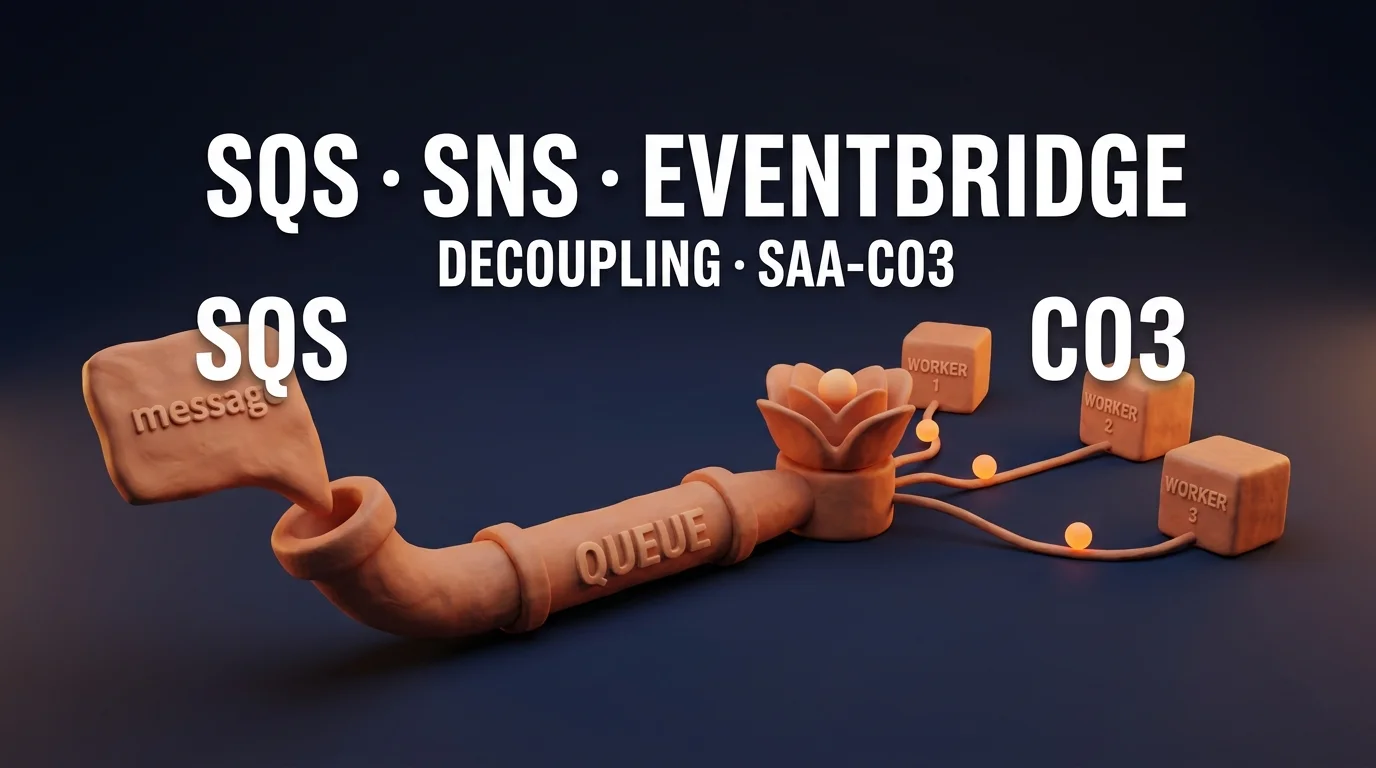
Loose coupling is an AWS design principle and a reliable source of SAA-C03 questions, and three services deliver it: SQS, SNS, and EventBridge. They overlap enough to confuse and differ enough that the wrong one is a wrong answer. This guide draws the lines, covers the fan-out pattern that combines them, and maps the scenarios AWS tests.
Decoupling sits in the Resilience domain (26%); pair this with the high availability guide for the full picture.
Find out where you stand first
Take the free SAA-C03 sample questions cold (no signup, real exam style), then read on with your gaps in mind. When you are ready for full rehearsal, Preporato's SAA-C03 practice tests include 6 full-length exams (401 questions in total, domain-proportional, every answer explained) for a one-time $19.99 with lifetime access.
Why Decouple at All
A tightly-coupled system calls its components directly and synchronously, so a slow or failed downstream drags everything with it: the web tier waits on the processing tier, and if processing is down, requests are lost. Inserting a messaging layer lets components produce and consume work independently. The web tier hands work to a queue and moves on; the processing tier pulls when it can; a traffic spike fills the buffer instead of dropping requests. That independence is both a resilience and a scalability win, which is why the exam reaches for it constantly.
Preparing for SAA-C03? Practice with 390+ exam questions
The Three Services
SQS vs SNS vs EventBridge
| SQS | SNS | EventBridge | |
|---|---|---|---|
| Model | Queue (point-to-point) | Pub/Sub (fan-out) | Event bus (routing) |
| Delivery | Pull (consumers poll) | Push (to subscribers) | Push (to targets by rule) |
| Relationship | One producer -> one consumer group | One publisher -> many subscribers | Many sources -> routed targets |
| Buffering | Yes, stores messages until processed | No, delivers immediately | No, routes immediately |
| Best for | Decouple and buffer work | Broadcast one event to many | Route events by content, integrate SaaS/AWS |
SQS is a queue: a producer puts messages in, a consumer pulls them out, and messages wait until processed. Its superpower is buffering: it absorbs load spikes and shields consumers from being overwhelmed. Two flavors:
- Standard: near-unlimited throughput, at-least-once delivery, best-effort ordering (occasional duplicates and reordering).
- FIFO: strict ordering and exactly-once processing, lower throughput. The answer when the stem says "order must be preserved" or "no duplicates."
SNS is pub/sub: a publisher sends to a topic and every subscriber gets a copy, pushed immediately. It fans one event out to many recipients (email, SQS queues, Lambda, HTTP). No buffering, so if a subscriber is down when the message is sent, it misses it, unless the subscriber is an SQS queue.
EventBridge is an event bus with content-based routing: events from AWS services, SaaS partners, or your apps flow in, and rules route each to targets based on its content. It carries a schema registry and native integrations SNS lacks. The answer when the stem describes "route different event types to different targets" or "react to events from a SaaS application."
The Fan-Out Pattern (SNS + SQS)
The most-tested combination: SNS fans an event out to multiple SQS queues, one per consumer. This marries SNS's broadcast with SQS's durability, so each consumer gets its own buffered copy and none miss a message even if temporarily down.
Order placed -> SNS topic ─┬─> SQS: billing queue    -> billing service
                           ├─> SQS: shipping queue   -> shipping service
                           └─> SQS: analytics queue  -> analytics service
A scenario where "one event must reliably reach several independent systems, each processing at its own pace" is describing SNS + SQS fan-out. Plain SNS alone risks a down subscriber missing the event; the SQS queues fix that with buffering.
Master These Concepts with Practice
Our SAA-C03 practice bundle includes:
- 6 full practice exams (390+ questions)
- Detailed explanations for every answer
- Domain-by-domain performance tracking
30-day money-back guarantee
Choosing Under Pressure
The decision the exam makes you make, distilled:
- One producer, one consumer, buffer the load -> SQS.
- Order matters or no duplicates -> SQS FIFO.
- Broadcast one event to many consumers -> SNS (or SNS + SQS for durability).
- Route events by their content to different targets, or ingest SaaS/AWS events -> EventBridge.
- Scale a worker fleet with the backlog -> SQS queue depth as the Auto Scaling metric.
A useful tiebreaker: if the question emphasizes routing logic ("send order events here, inventory events there"), it is EventBridge; if it emphasizes broadcast ("notify all these systems"), it is SNS; if it emphasizes buffering and independent processing, it is SQS.
Practice the pattern recognition
Decoupling questions reward instinct built from reps. Week 6 of the 8-week study plan has a Free Tier lab building SNS + SQS fan-out, and the study guide walks the patterns with diagrams.
How This Shows Up on the Exam
- A spike in orders overwhelms the processing service and requests are lost. (Buffer with an SQS queue; scale consumers on queue depth.)
- Payment events must be processed in exact order with no duplicates. (SQS FIFO.)
- One "order placed" event must reach billing, shipping, and analytics reliably and independently. (SNS + SQS fan-out.)
- Route events from a third-party SaaS to different Lambda functions by event type. (EventBridge with routing rules.)
- Broadcast a notification to email, a queue, and a Lambda at once. (SNS topic with multiple subscribers.)
Key Takeaways
- SQS = queue that buffers; SNS = pub/sub broadcast; EventBridge = event bus with content routing
- SQS FIFO when order or exactly-once matters; Standard for maximum throughput
- SNS + SQS fan-out gives broadcast plus per-consumer durability, the canonical reliable pattern
- EventBridge when routing logic or SaaS/AWS event integration is the requirement
- Scale consumers on SQS queue depth to absorb spikes gracefully
Continue with cost optimization, or drill decoupling scenarios in Preporato's SAA-C03 practice exams.
Sources:
Last updated: July 10, 2026
Ready to Pass the SAA-C03 Exam?
Join thousands who passed with Preporato practice tests