
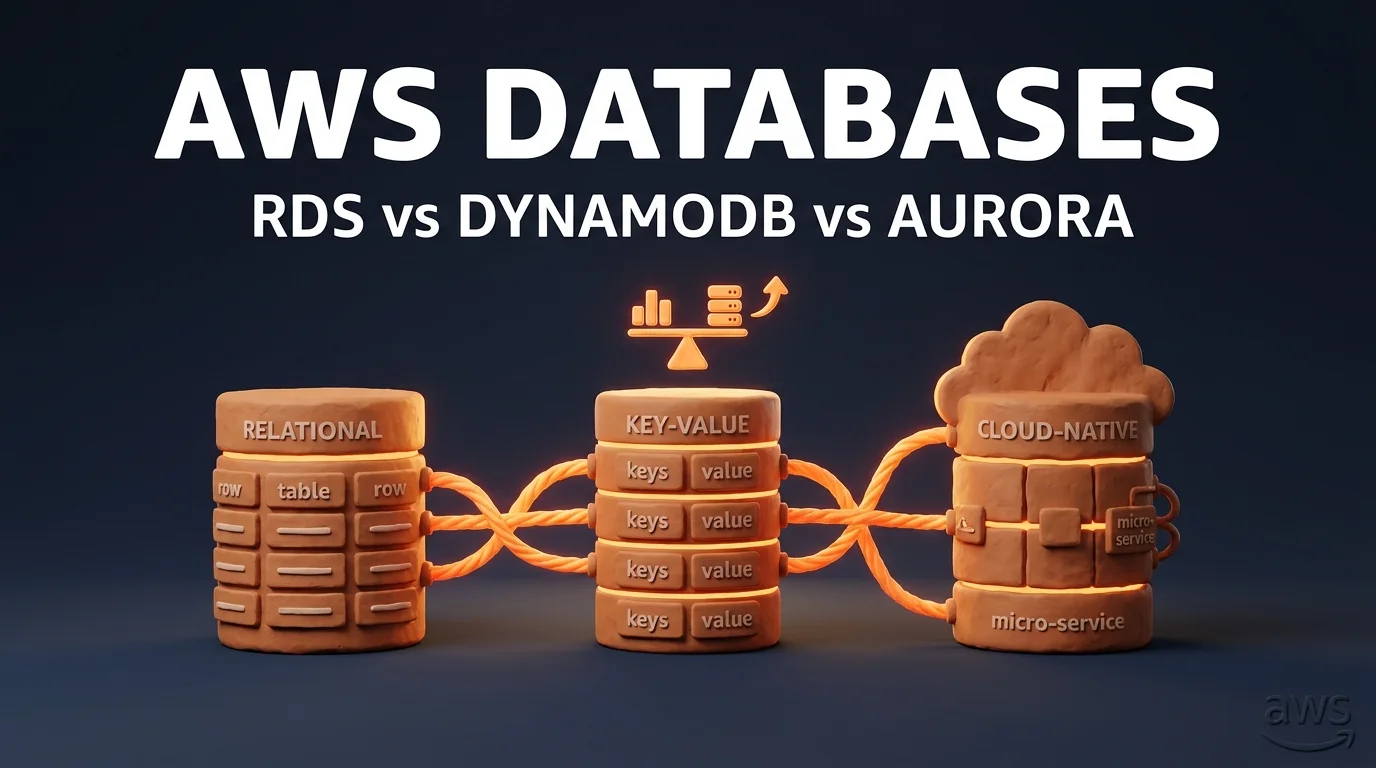
Database questions on SAA-C03 are selection puzzles: the stem describes a workload and asks which managed database, or which feature of one, fits. Get the mental model of what each database is for and the questions become fast; guess between them and you will burn time and points. This guide covers the databases AWS tests and, more importantly, the decisions between them.
For the full service map, see the domains breakdown; this piece goes deep on the data layer.
Find out where you stand first
Take the free SAA-C03 sample questions cold (no signup, real exam style), then read on with your gaps in mind. When you are ready for full rehearsal, Preporato's SAA-C03 practice tests include 6 full-length exams (401 questions in total, domain-proportional, every answer explained) for a one-time $19.99 with lifetime access.
The Big Split: Relational vs NoSQL
Start every database question by classifying the workload:
- Relational (SQL): structured data, joins, transactions, a fixed schema. AWS answers: RDS and Aurora.
- NoSQL (key-value / document): massive scale, flexible schema, predictable single-digit-millisecond access by key. AWS answer: DynamoDB.
The stem's language routes you: "complex queries and joins," "existing MySQL/PostgreSQL app," "ACID transactions" point relational; "millions of requests per second," "flexible schema," "single-digit millisecond latency at any scale" point DynamoDB.
Preparing for SAA-C03? Practice with 390+ exam questions
RDS: Managed Relational, and the Multi-AZ vs Read Replica Trap
RDS runs managed MySQL, PostgreSQL, MariaDB, Oracle, and SQL Server. The most-tested RDS concept is a pair of features candidates confuse:
Multi-AZ vs Read Replicas (memorize this)
| Multi-AZ | Read Replicas | |
|---|---|---|
| Purpose | High availability / failover | Scaling read traffic |
| Replication | Synchronous to a standby | Asynchronous to replicas |
| Standby usable? | No, it only takes over on failure | Yes, serves read queries |
| Failover | Automatic on AZ/instance failure | Manual promotion possible |
| Answers the stem | "survive an AZ failure," "no downtime" | "offload reporting," "scale reads" |
This single distinction appears on nearly every exam. Multi-AZ is availability; read replicas are read scaling. They are not substitutes, and a question can require both (a Multi-AZ primary plus read replicas for a read-heavy, HA app). A stem that says "reporting queries are slowing the production database" wants read replicas; one that says "the database must survive an Availability Zone outage" wants Multi-AZ.
Aurora: Cloud-Native Relational
Aurora is AWS's MySQL- and PostgreSQL-compatible database built for the cloud: storage auto-scales, data is replicated six ways across three AZs, and it delivers substantially higher throughput than standard RDS. Know:
- Up to 15 Aurora Replicas with fast failover; the replicas share the same storage volume, so replication lag is minimal.
- Aurora Serverless v2 scales capacity automatically for variable or unpredictable workloads; the "spiky relational load, don't manage capacity" answer.
- Global Database for cross-Region replication with low-latency reads and DR.
Aurora is the answer when a relational scenario stresses high throughput, high availability, or managed scaling beyond what plain RDS offers, and cost is not the overriding constraint.
Master These Concepts with Practice
Our SAA-C03 practice bundle includes:
- 6 full practice exams (390+ questions)
- Detailed explanations for every answer
- Domain-by-domain performance tracking
30-day money-back guarantee
DynamoDB: Serverless NoSQL at Scale
DynamoDB is a fully managed key-value and document store with single-digit-millisecond latency at any scale and no servers to manage. The exam-relevant mechanics:
- Partition (hash) key design drives performance; a poorly chosen key creates hot partitions. "Requests are throttling despite low overall usage" often means an uneven partition key.
- Capacity modes: On-Demand (pay per request, unpredictable traffic) vs Provisioned (cheaper for steady, predictable traffic, with optional auto-scaling).
- DAX (DynamoDB Accelerator): an in-memory cache giving microsecond reads; the "make DynamoDB reads even faster" answer.
- Global Tables: multi-Region, multi-active replication; the "low-latency global access and Region-level DR for a NoSQL store" answer.
- TTL: auto-expire items (sessions, temporary data) with no cost.
DynamoDB wins scenarios about serverless architectures, extreme scale, session stores, and flexible-schema data.
Caching and Analytics
Two databases that answer specific keywords:
- ElastiCache (Redis or Memcached): in-memory caching to offload read-heavy databases and cut latency. Redis when you need persistence, replication, or pub/sub; Memcached for simple, horizontally-sharded caching. The "reduce database load / speed up repeated reads" answer for relational workloads.
- Redshift: a columnar data warehouse for OLAP analytics over large datasets. The answer for "run complex analytical queries across terabytes," and the wrong answer for transactional (OLTP) workloads.
Build the decision reflex
Database selection is pure pattern recognition, which practice questions build faster than reading. The SAA-C03 study guide walks each engine, and week 4 of the 8-week plan is devoted to databases.
How This Shows Up on the Exam
- Reporting queries slow the production RDS database. (Add read replicas to offload reads.)
- The database must continue through an AZ failure with automatic failover. (Enable Multi-AZ.)
- A relational workload with unpredictable spikes and no desire to manage capacity. (Aurora Serverless v2.)
- A session store needing single-digit-ms reads at massive scale, serverless. (DynamoDB, with DAX if microsecond reads are required.)
- Complex analytics across terabytes of historical data. (Redshift, not RDS.)
- Repeated identical reads are hammering the database. (Put ElastiCache in front.)
Key Takeaways
- Classify first: relational (RDS/Aurora) vs NoSQL key-value (DynamoDB)
- Multi-AZ = availability/failover; read replicas = read scaling. Never interchangeable.
- Aurora for high-throughput, highly-available relational; Serverless v2 for variable load; Global Database for cross-Region
- DynamoDB for serverless scale; partition-key design matters; DAX for microsecond reads; Global Tables for multi-Region
- ElastiCache to offload read-heavy databases; Redshift for OLAP analytics, never OLTP
Continue with high availability and disaster recovery, or drill database scenarios in Preporato's SAA-C03 practice exams.
Sources:
Last updated: July 10, 2026
Ready to Pass the SAA-C03 Exam?
Join thousands who passed with Preporato practice tests