
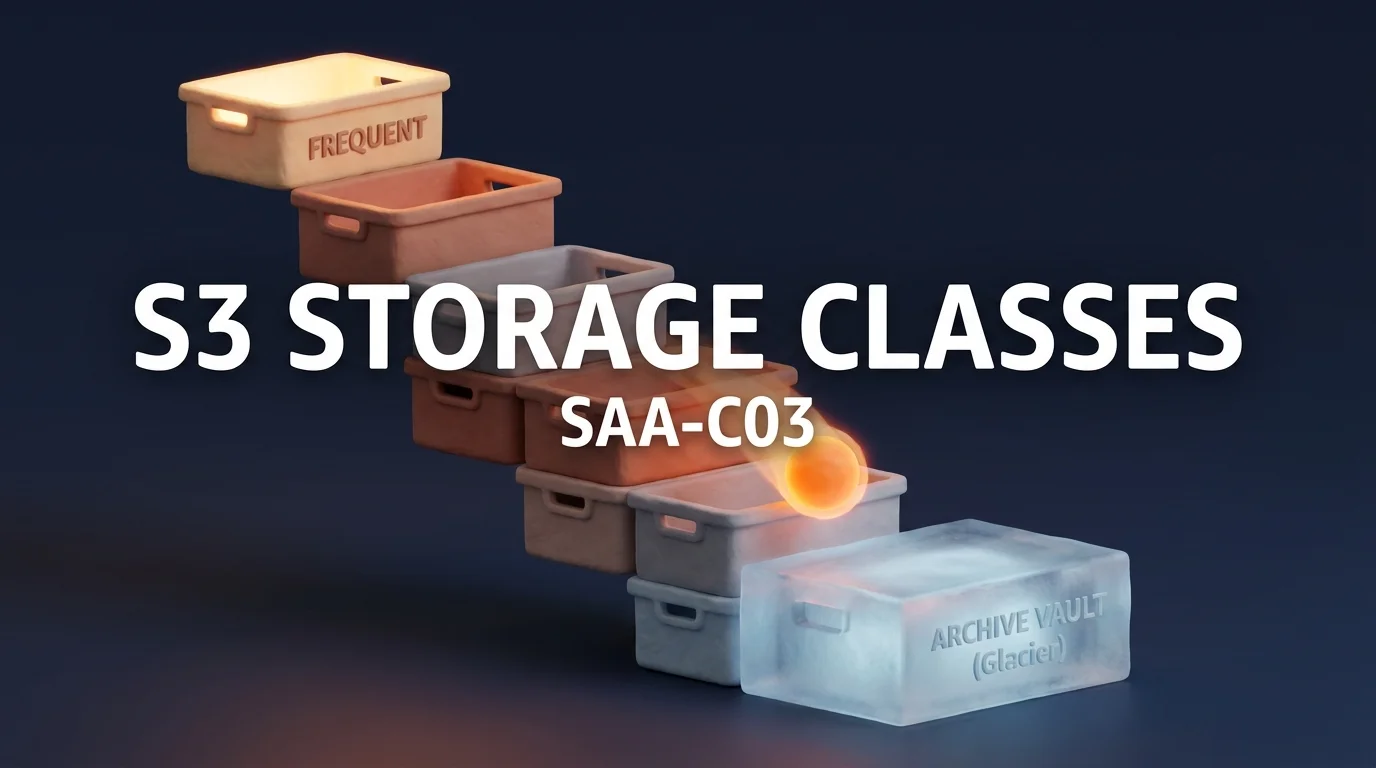
S3 shows up in every SAA-C03 domain, but its highest-density questions are storage-class selection: given an access pattern and a cost or durability requirement, which class? These are near-free points once you know the classes, and near-guaranteed misses when you guess. This guide covers each class, lifecycle automation, and the decision rules AWS tests.
For the full storage picture (EBS, EFS, FSx), see the domains breakdown; this piece goes deep on S3 specifically.
Find out where you stand first
Take the free SAA-C03 sample questions cold (no signup, real exam style), then read on with your gaps in mind. When you are ready for full rehearsal, Preporato's SAA-C03 practice tests include 6 full-length exams (401 questions in total, domain-proportional, every answer explained) for a one-time $19.99 with lifetime access.
The Durability Baseline
Every S3 class except One Zone stores objects redundantly across at least three Availability Zones, giving eleven nines (99.999999999%) of durability. Availability (uptime for retrieval) varies by class; durability (not losing the object) is effectively constant except where a class explicitly trades an AZ. That distinction, durability vs availability, is itself an exam point.
Preparing for SAA-C03? Practice with 390+ exam questions
The Classes, by Access Pattern
S3 storage classes
| Class | Access pattern | Retrieval | Cost note |
|---|---|---|---|
| S3 Standard | Frequent | Immediate | Highest storage, no retrieval fee |
| S3 Intelligent-Tiering | Unknown / changing | Immediate | Auto-moves objects between tiers; small monitoring fee, no retrieval fee |
| S3 Standard-IA | Infrequent, fast when needed | Immediate | Lower storage, per-GB retrieval fee, min 30 days |
| S3 One Zone-IA | Infrequent, re-creatable | Immediate | ~20% cheaper than Standard-IA, single AZ (no multi-AZ durability) |
| S3 Glacier Instant Retrieval | Archive, needs instant access | Immediate | Cheap storage, higher retrieval fee |
| S3 Glacier Flexible Retrieval | Archive, minutes to hours | Minutes-hours | Very cheap; bulk/standard/expedited retrieval tiers |
| S3 Glacier Deep Archive | Rarely accessed, compliance | Hours (up to 12) | Cheapest storage in AWS |
The selection logic the exam wants:
- Frequent access -> Standard.
- Access pattern is unknown or changes -> Intelligent-Tiering. This is the safest "cost-effective" answer when the stem says access is unpredictable, because it auto-optimizes without retrieval fees.
- Infrequent but must be instant -> Standard-IA (or One Zone-IA if the data can be re-created and you accept single-AZ risk for the discount).
- Archive, needs immediate retrieval -> Glacier Instant Retrieval.
- Archive, can wait minutes to hours -> Glacier Flexible Retrieval.
- Archive, rarely touched, cheapest possible -> Glacier Deep Archive.
The One Zone trap: it is cheaper because it lives in a single AZ, so an AZ failure can lose it. Correct only when the data is reproducible (thumbnails, re-derivable logs). A question offering One Zone-IA for irreplaceable data is the distractor.
Lifecycle Policies: Automating the Journey
You rarely pick one class forever. Lifecycle policies transition objects between classes and expire them on a schedule:
- Transition: "move objects to Standard-IA after 30 days, to Glacier after 90, expire after 7 years."
- Expiration: delete objects (and old versions) automatically.
A scenario describing "logs accessed heavily for a month, occasionally for a quarter, then kept for compliance but rarely read" is a lifecycle policy walking Standard -> Standard-IA -> Glacier Deep Archive. Recognizing the pattern is the answer, and it is a favorite because it tests cost thinking and storage classes at once.
Master These Concepts with Practice
Our SAA-C03 practice bundle includes:
- 6 full practice exams (390+ questions)
- Detailed explanations for every answer
- Domain-by-domain performance tracking
30-day money-back guarantee
Access, Versioning, and Protection
Exam-relevant S3 features beyond storage class:
- Versioning keeps every version of an object; pair with lifecycle to expire old versions and with MFA Delete for protection against accidental or malicious deletion.
- Bucket policies and IAM control access; blocking public access is the default and the "secure the bucket" answer. Public buckets are a classic wrong architecture.
- Encryption: SSE-S3 (AWS-managed keys), SSE-KMS (customer control and audit trail), or SSE-C (you supply keys). "Data at rest must be encrypted with an audit trail of key use" points to SSE-KMS.
- Replication: Cross-Region Replication (CRR) for DR and latency, Same-Region Replication (SRR) for log aggregation or compliance. CRR is the "keep a copy in another Region" answer.
- S3 Transfer Acceleration speeds long-distance uploads via edge locations; the answer for "users worldwide upload large files to one bucket."
Cost thinking is the theme
S3 class selection is really cost optimization (20% of the exam) meeting storage. The cost optimization guide covers the broader pricing models these questions lean on.
How This Shows Up on the Exam
- Data with an unpredictable, changing access pattern, minimize cost without retrieval surprises. (Intelligent-Tiering.)
- Thumbnails that can be regenerated, stored cheaply, infrequent access. (One Zone-IA.)
- Compliance archive kept 7 years, retrieval within 12 hours acceptable, cheapest option. (Glacier Deep Archive.)
- Logs hot for a month, then rarely read but retained for years. (Lifecycle policy transitioning across classes.)
- Keep a durable copy of a bucket in a second Region for DR. (Cross-Region Replication.)
Key Takeaways
- All classes give eleven nines durability except One Zone, which trades an AZ for ~20% savings
- Intelligent-Tiering is the safe cost answer when access patterns are unknown (no retrieval fees)
- One Zone-IA only for re-creatable data; never for irreplaceable objects
- Glacier tiers ladder by retrieval speed: Instant, Flexible (minutes-hours), Deep Archive (hours, cheapest)
- Lifecycle policies automate the class-to-class journey and expiration
- SSE-KMS for encryption with an audit trail; CRR for cross-Region durability
Continue with databases, or test storage scenarios in Preporato's SAA-C03 practice exams.
Sources:
Last updated: July 10, 2026
Ready to Pass the SAA-C03 Exam?
Join thousands who passed with Preporato practice tests