
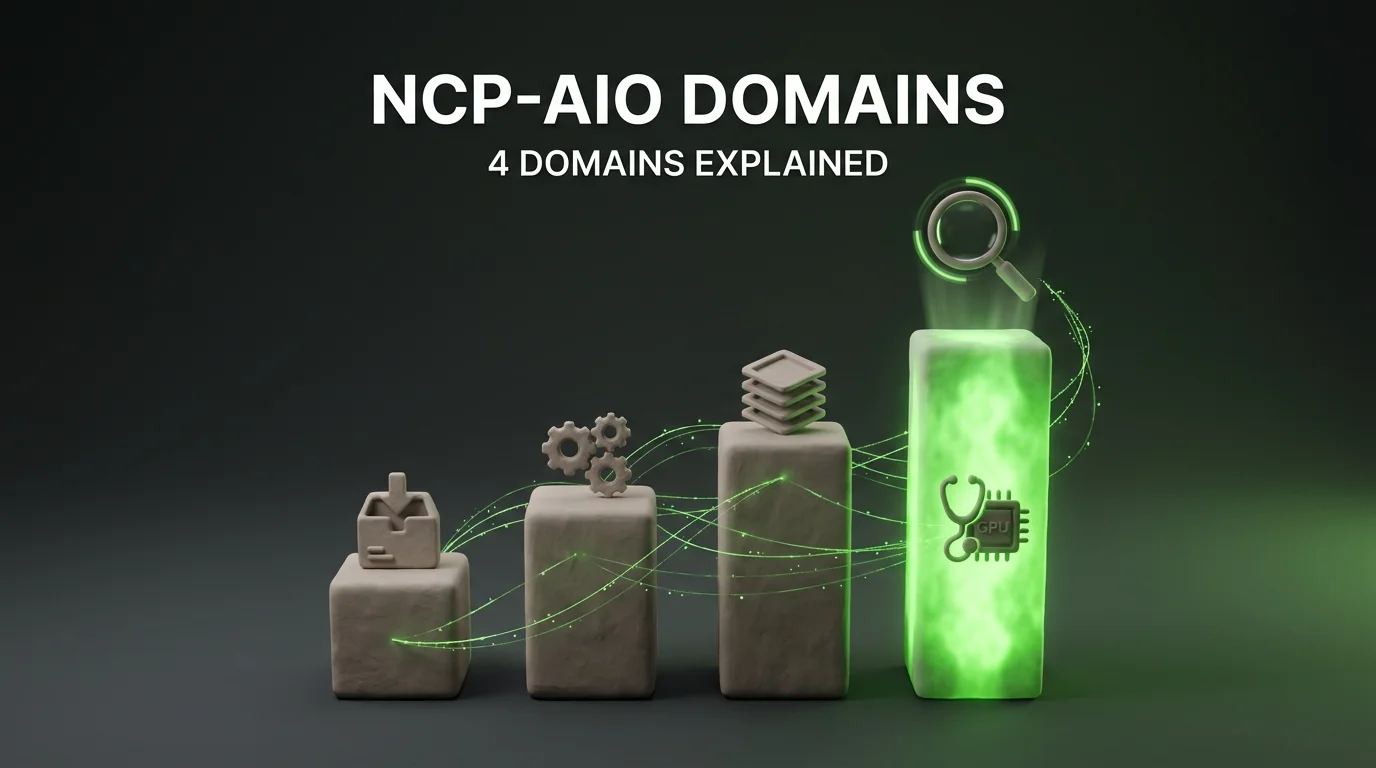
The NCP-AIO blueprint has four domains, and after Installation & Deployment at 31%, the remaining three split evenly at 23% each. That flatness is a preparation instruction in itself: you cannot afford a weak domain, because every one of them carries near-quarter weight, and the exam's 3 hands-on lab exercises can draw from any of them.
This breakdown covers each domain topic by topic at exam depth. For format and registration, read the complete NCP-AIO guide; for the calendar, use the 6-week plan.
Find out where you stand first
Take the free NCP-AIO sample questions cold (no signup, real exam style), then read on with your gaps in mind. When you are ready for full rehearsal, Preporato's NCP-AIO practice tests include 7 full-length exams (420 questions in total, domain-proportional, every answer explained) for a one-time $19.99 with lifetime access.
The lab-exercise lens
With 30 multiple-choice questions plus 3 live lab exercises, read every topic below twice: once as a knowledge item (can I answer questions about it?) and once as an operation (can I do it in a terminal without lookups?). The second reading is what the lab section grades.
Domain 1: Installation & Deployment (31%)
Base Command Manager installation. BCM is the cluster manager at the center of NVIDIA's operations stack: a head node that provisions compute nodes from images, manages their software lifecycle, and exposes cluster state through cmsh and Base View. Know the installation flow, license activation, node categories and images, and how adding nodes to a running cluster works.
NVIDIA Mission Control. The newer deployment and operations toolkit for large NVIDIA clusters, wrapping cluster bring-up, validation, and ongoing operations workflows. Exam questions position it relative to BCM, so know what each layer owns.
Firmware and driver management. Fleet-wide driver updates without breaking the qualified stack, kernel module handling, and the sequencing rule (drain workloads, update, validate, return to service).
Scheduler layer installation. Slurm installation and initial configuration on a BCM-managed cluster, Kubernetes installation with the GPU Operator (drivers, container toolkit, device plugin, DCGM exporter as operator-managed components), and where each scheduler fits: Slurm for batch training, Kubernetes for services and inference.
Run:ai and DOCA services deployment. Run:ai installs on top of Kubernetes and adds GPU-aware orchestration (projects, quotas, fractional GPUs). DOCA services run infrastructure functions on BlueField DPUs. For both, the exam expects deployment-level understanding: prerequisites, installation order, verification.
Cluster diagnostics at deployment time. Network configuration checks and the validation pass that confirms a deployment before users arrive.
Deploy the scheduler layer once, answer its questions forever
Stand up the GPU Operator on k3s and walk the chain from Helm release to schedulable GPU, then trace each operator component. The installation questions become recognition.
Preparing for NCP-AIO? Practice with 455+ exam questions
Domain 2: Administration (23%)
Slurm administration. The deepest single topic on the exam. Beyond job submission, know:
- Partitions: limits, priorities, and what belongs in which partition
- GRES (generic resources): how GPUs are declared (
gres.conf) and requested (--gres=gpu:2) - QoS and fair-share: the mechanisms that stop one team from starving another
- Accounting:
sacctandsacctmgrfor usage tracking and limits - Node state management: drain, resume, and why a node shows
drngordown
Kubernetes and Run:ai administration. Namespaces and resource quotas for tenancy, GPU requests and limits, and the Run:ai layer above: projects mapped to quotas, over-quota scheduling (idle GPUs are borrowable and reclaimed when the owner returns), and fractional GPU allocation for underutilizing workloads.
MIG management. Reconfiguring MIG geometry as tenant needs change: the instance profiles (1g.10gb through 7g.80gb on H100-class parts), the idle-GPU requirement for reconfiguration, and how MIG instances surface in Slurm GRES and the Kubernetes device plugin (single versus mixed strategy).
User management and access control. Cluster-level accounts and associations in Slurm, RBAC in Kubernetes, and keeping tenant boundaries real in a shared cluster.
Data center architecture for AI. Operations-level architecture awareness: separate compute, storage, and management networks, where the scheduler sees topology, and what an operator must know about the fabric without owning it (fabric ownership is the NCP-AIN exam's territory).
Multi-tenancy mechanics on a live cluster
Set resource requests and limits, configure PriorityClass and watch preemption evict the right pod, and target workloads across mixed GPU pools. The administration questions test exactly these mechanisms.
Master These Concepts with Practice
Our NCP-AIO practice bundle includes:
- 7 full practice exams (455+ questions)
- Detailed explanations for every answer
- Domain-by-domain performance tracking
30-day money-back guarantee
Domain 3: Workload Management (23%)
Distributed training deployment. Launching multi-node training correctly: Slurm batch scripts with GRES requests, container-based launches through Pyxis and Enroot (the Slurm container plugins), stable rendezvous for PyTorch DDP/NCCL (master address, world size), and checkpointing discipline so failures resume rather than restart.
Inference deployment with Triton and NIM. Triton Inference Server is the exam's inference workhorse: model repository layout, dynamic batching (queuing requests briefly to batch them for throughput), concurrent model execution, and instance groups. NIM (NVIDIA Inference Microservices) packages models as containerized services with standard APIs; know when NIM's turnkey shape beats hand-built Triton deployments.
NGC container management. Pulling and running NVIDIA's optimized containers, the ngc CLI, registry authentication, and version pinning against the qualified stack.
Resource allocation and scheduling policy. Translating business priority into scheduler policy: preemption for urgent jobs, backfill for utilization, gang scheduling for distributed workloads, and quota design that reflects team budgets.
Job monitoring. Watching what workloads actually do: squeue/sacct in Slurm, pod and job status in Kubernetes, GPU utilization per job, and spotting the job that requested 8 GPUs to use one.
Serve, batch, and roll out like the exam expects
Deploy Triton-pattern inference with dynamic batching, serve LLMs with vLLM, pick the right controller per workload shape, and run rolling, canary, and blue-green updates for inference services.
- Open labInference Serving Patterns: Dynamic Batching, Throughput, and the Triton Mental Modelintermediate 40 minGPU sandbox
- Open labvLLM Production Serving: PagedAttention, Continuous Batching, Prefix Cachingadvanced 55 minGPU sandbox
- Open labWorkload Controllers — Deployment, StatefulSet, DaemonSet for AIintermediate 35 minHosted
- Open labRolling Updates, Rollback & Blue-Green for AI Inferenceintermediate 35 minHosted
Domain 4: Troubleshooting & Optimization (23%)
The troubleshooting domain rewards a layered decision tree. Practice classifying every symptom into one of five layers before reaching for a fix:
GPU hardware layer (Xid and ECC). Xid codes in the kernel log: 79 (GPU off the bus, hardware attention), 48 (double-bit ECC), 63/64 (row remapping), thermal and power events. ECC error accounting: volatile versus aggregate counters, and when row remapping means a replacement conversation. DCGM is the tooling: health watches, dcgmi diag levels, policy-based alerts.
Fabric layer (NVLink/NVSwitch). Fabric Manager must run for NVLink fabric operation on NVSwitch systems; know its failure signature (jobs that need peer-to-peer fail while single-GPU work runs fine) and the nvidia-smi nvlink counters that expose degraded links.
Scheduler layer. Jobs pending forever (quota exhaustion, impossible GRES requests, drained nodes), jobs killed at limits, and the Slurm/Kubernetes state queries that reveal each.
Container layer. Image pull failures, container toolkit misconfiguration (GPU not visible inside the container), permission and runtime-class problems.
Storage and network layer. The bottleneck taxonomy: dataloader starvation versus storage throughput versus network congestion, and the measurement order that identifies the layer before any component gets blamed.
BCM troubleshooting. Node provisioning failures, image sync problems, and head-node service health.
The diagnosis reps the lab exercises reward
Build a DCGM-based health watchdog with auto-remediation, wire a GPU observability pipeline from nvidia-smi to Prometheus, and run a triage day against four differently-broken GPU pods.
Working the Blueprint
Every topic above appears twice on this exam: as a question and as a potential live exercise. Cover the knowledge with weighted practice tests, and cover the fluency with labs. Preporato's NCP-AIO prep provides both: 7 full-length practice exams (420 explained questions, per-domain tracking) and 19 hands-on GPU labs mapped to these domains. Review with the cheat sheet and finish with the first-attempt strategy.
Sources:
- NVIDIA NCP-AIO Official Certification Page
- NVIDIA Base Command Manager Documentation
- NVIDIA Triton Inference Server Documentation
- Slurm Workload Manager Documentation
Last updated: July 9, 2026
Ready to Pass the NCP-AIO Exam?
Join thousands who passed with Preporato practice tests