
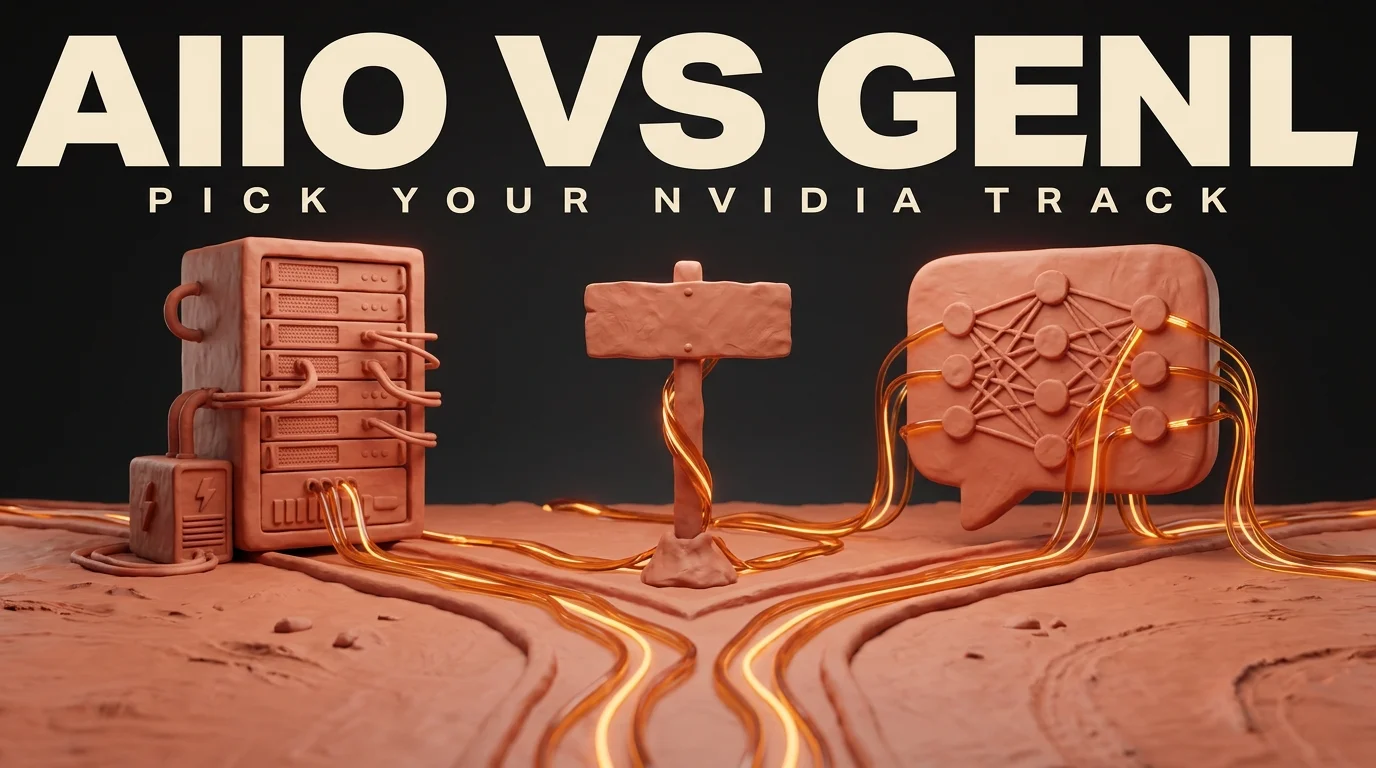
NVIDIA's two flagship associate certifications point at different careers. NCA-AIIO certifies that you understand the infrastructure AI runs on: GPU systems, networking, cooling, monitoring. NCA-GENL certifies that you understand what runs on it: large language models, prompting, fine-tuning, the generative AI application stack. People searching for "NVIDIA certification" usually land on this fork without knowing it exists, so this comparison makes the fork explicit and gives you the one question that settles it: do you want to run the machines, or build with the models?
Find out where you stand first
Take the free NCA-AIIO sample questions cold (no signup, real exam style), then read on with your gaps in mind. When you are ready for full rehearsal, Preporato's NCA-AIIO practice tests include 7 full-length exams (420 questions in total, domain-proportional, every answer explained) for a one-time $19.99 with lifetime access.
What each exam covers
NCA-AIIO (AI Infrastructure and Operations) is 50 questions in 60 minutes for $125. Its three domains are Essential AI Knowledge at 38%, AI Infrastructure at 40%, and AI Operations at 22%, which in practice means GPU versus CPU architecture, the CUDA software stack, DGX and HGX platforms, NVLink and InfiniBand, power and cooling, reference architectures, DCGM monitoring, and GPU partitioning with MIG. The complete guide walks the full syllabus.
NCA-GENL (Generative AI with LLMs) is 50-60 questions in 60 minutes for $125. It tests the model side: transformer fundamentals, prompt engineering, fine-tuning approaches, retrieval-augmented generation, the NeMo and NIM ecosystem, and responsible AI. The NCA-GENL guide covers its structure and preparation path.
Both are online proctored, knowledge-based, valid for two years, and pitched at the associate level, so difficulty and format will not decide this for you. Content fit will.
Try 15 NCA-AIIO practice questions free
They come from the NCA-AIIO practice tests, and each option shows its explanation once you answer.
- 7 timed practice exams
- Every answer explained
- A score for each domain
- $19.99 one-time
Who each certification fits
Choose NCA-AIIO if your background is systems. Data center technicians, sysadmins, network and storage engineers, virtualization specialists, DevOps and SRE people: your existing skills transfer directly, the exam vocabulary is your vocabulary with GPUs added, and the roles it signals for (GPU cluster operations, AI data center roles) are natural promotions from where you stand. The worth-it assessment covers the career case in depth.
Choose NCA-GENL if your background is code or data. Developers, data scientists, ML practitioners, and technically-minded product people get far more from the model track: it maps to the work of building LLM applications, and it chains toward NCP-GENL and the agentic AI professional cert (NCP-AAI) rather than toward rack elevations and cooling budgets.
If you are neither, meaning you are entering AI from scratch and could go either way, pick by job market fit rather than curiosity: infrastructure roles are scarcer in count but less crowded with applicants, while generative AI roles are more numerous and more contested. The infrastructure track rewards people who enjoy operations discipline; the GenAI track rewards people who enjoy building and iterating.
Three questions from the NCA-AIIO practice tests
A new GPU server runs Docker. On the host, nvidia-smi lists all eight GPUs. Inside a CUDA container from the NGC catalog, the same command fails with "command not found", and the application reports that no CUDA-capable device was detected. The image works unchanged on other servers. What is missing on the new server?
[object Object]
Correct. Containers do not include the kernel driver. The NVIDIA Container Toolkit hooks into the container runtime and exposes the GPU devices and the host's user-mode driver files, including nvidia-smi, to GPU containers.
A. DCGM monitors, configures and diagnoses GPUs. It plays no part in granting containers access to GPU devices.
B. A container carries its own CUDA runtime libraries, so the host needs a working NVIDIA driver, which it has. A host CUDA Toolkit does not expose GPUs to Docker.
C. The GPU Operator automates the NVIDIA software stack on Kubernetes nodes. This server runs plain Docker; the Container Toolkit is the piece the Operator would install for it.
A Kubernetes cluster runs distributed training jobs that each need 4 worker pods with 8 GPUs per pod. When the cluster is busy, the default scheduler starts 3 of a job's pods, which then hold 24 GPUs for hours while they wait for the fourth. What scheduling capability fixes this?
[object Object]
Correct. A distributed job only progresses when every worker runs. Gang scheduling binds the pod group as a unit, all pods or none, so partial jobs never sit on GPUs. The Run:ai scheduler applies it to distributed training workloads.
A. Time-slicing gives pods turns on the same GPU with no memory isolation. It does not make the scheduler place a job's pods together, and workers sharing GPUs would train far slower.
B. Kubernetes does not allow this for GPUs. GPUs are specified in limits, and if a request is given it must equal the limit.
D. Priority decides which pods win under contention, but the default scheduler still places pods one at a time, so two large jobs can each end up partly placed and stuck.
You are mapping traffic onto the four networks of an NVIDIA DGX SuperPOD design: the compute fabric, the storage fabric, in-band management and out-of-band management. Which assignment matches the reference architecture?
[object Object]
Correct. GPU-to-GPU traffic uses the InfiniBand compute fabric, storage I/O uses its own storage fabric, cluster services such as Base Command Manager, Slurm and NGC access use in-band management, and BMCs and PDUs sit on the isolated out-of-band network.
B. This swaps the two InfiniBand fabrics. GPU collectives such as NCCL all-reduce run on the compute fabric, and storage I/O runs on the storage fabric so the two do not compete.
C. This swaps the management networks. Slurm and Base Command Manager use in-band management, while BMC and PDU access belongs on the logically separate out-of-band network.
D. Dataset reads belong on the storage fabric, which the design sizes for high-bandwidth I/O. In-band management carries cluster services such as Slurm and Base Command Manager.
Full NCA-AIIO set: 7 timed exams, every answer explained, $19.99 one-time.
See the practice testsCan you take both?
Yes, and the pairing is more coherent than it looks, since the AI Infrastructure exam's 38% Essential AI Knowledge domain overlaps meaningfully with GENL's fundamentals. The efficient order for a both-tracks plan is the one matching your day job first, the other within the same year while the shared material is fresh. At $125 plus $125, the pair costs less than most single cloud certifications and covers the field from silicon to application.
Decide, then measure
Settle the fork with the one question (machines or models), then take a free diagnostic before committing study weeks: 12 NCA-AIIO practice questions for the infrastructure track, or the NCA-GENL cheat sheet to gauge the model track's scope. Full preparation for either lives on the cert pages: NCA-AIIO practice exams and NCA-GENL practice exams, each at real domain weights with every answer explained.
Sources: