
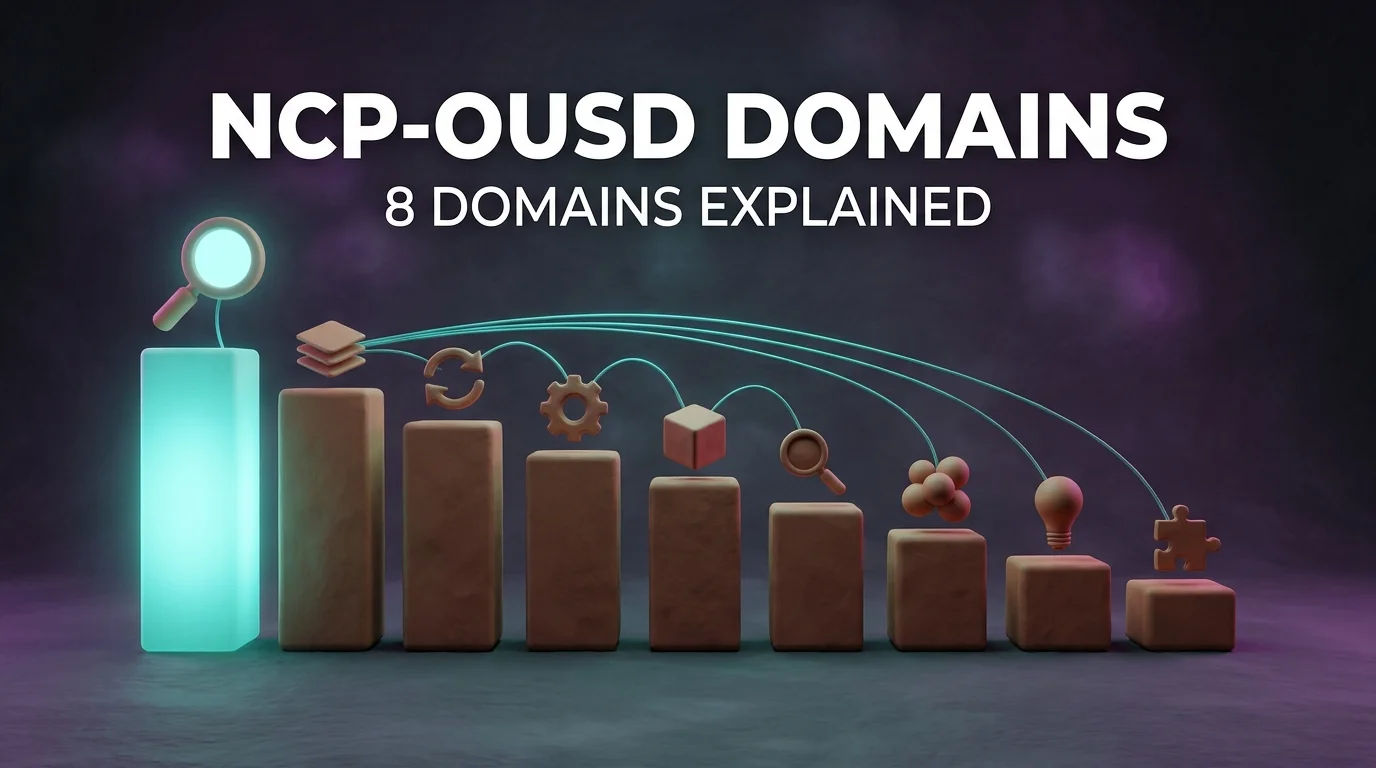
NCP-OUSD has eight domains, but they are far from equal. Composition alone is 23% of the exam, and the top four domains (Composition, Data Exchange, Pipeline Development, Data Modeling) together make up 65%. That distribution is a study instruction: master composition and the pipeline core, and the smaller domains follow. This article walks all eight topic by topic at the depth the exam expects.
New to the certification? Start with the complete NCP-OUSD guide. Ready to schedule the work? The 6-week plan sequences everything below.
Find out where you stand first
Take the free NCP-OUSD sample questions cold (no signup, real exam style), then read on with your gaps in mind. When you are ready for full rehearsal, Preporato's NCP-OUSD practice tests include 7 full-length exams (420 questions in total, domain-proportional, every answer explained) for a one-time $19.99 with lifetime access.
How to read the weights
At 60-70 questions, each percentage point is roughly two-thirds of a question. Composition (23%) contributes around 15 questions, Data Exchange (15%) around 10, and Customizing USD (6%) around 4. Study in weight order, and give composition the disproportionate attention its size demands.
Domain 1: Composition (23%)
The largest domain by far, and the intellectual core of USD. Composition is how a scene assembles from many layers, and its central rule is LIVERPS.
LIVERPS strength ordering. When multiple layers give opinions about the same property, USD resolves the conflict by arc strength, strongest to weakest:
- Local: opinions authored directly in the current layer stack (sublayers). Strongest.
- Inherits: a prim inherits from a class, so changes to the class broadcast to all instances.
- VariantSets: named, switchable variations (a "color" variant set with red/blue/green options).
- References: pull in another asset's prims, remapping them into the current scene.
- Payloads: like references but deferrable, so heavy geometry loads only when requested.
- Specializes: the weakest arc, providing fallback opinions that anything else overrides.
Memorize both the order and what each arc is for. The exam hands you a layer stack and asks which opinion wins, or which arc to use for a stated goal, and both require knowing LIVERPS cold.
References vs payloads. Both bring in external content; the difference is loading. A reference always loads; a payload can be unloaded to keep a heavy scene navigable, then loaded on demand. "The scene is too heavy to open; defer loading the detailed assets" points to payloads.
Sublayers. Layers stacked in the root layer's layer stack, composing local opinions in order (earlier sublayers are stronger). The mechanism behind non-destructive collaboration: each artist works in their own sublayer.
VariantSets, inherits, specializes. Variants switch between authored options; inherits broadcast a change from a class down to all inheriting prims (the way to change "all the chairs" at once); specializes provides base fallbacks. Know when each is the right tool.
Composition arc debugging and opinion resolution. Tracing why a particular opinion wins, which the debugging domain revisits with tools.
Preparing for NCP-OUSD? Practice with 455+ exam questions
Domain 2: Data Exchange (15%)
Moving 3D data in and out of USD.
Custom importer/exporter development. Writing code that translates between USD and other formats, and knowing where translation is lossy.
Format mapping (FBX, glTF, Alembic). Each format models 3D differently, so mapping to USD requires knowing what maps cleanly and what does not: Alembic is strong for baked animation and geometry caches, glTF for lightweight delivery and web, FBX for DCC interchange. The exam tests awareness of these trade-offs and their round-trip fidelity.
Interchange validation. Confirming that data survived a conversion: geometry, transforms, materials, and animation intact. Round-trip validation is a real exam concern.
USD file formats. Three to know cold:
- .usda: human-readable ASCII; editable in a text editor, ideal for small layers and learning.
- .usdc: binary "crate" format; compact and fast, for production data.
- .usdz: a zipped, uncompressed package for delivery (notably AR), bundling a stage and its assets.
"A large asset needs fast load in production" points to .usdc; "share an AR-ready package" points to .usdz; "hand-edit a small override layer" points to .usda.
Domain 3: Pipeline Development (14%)
Building the production plumbing around USD.
Asset management and versioning. Tracking asset versions and dependencies so a scene references the right revision and updates propagate predictably.
Pipeline automation with Python. The Python USD API is the workhorse for scripting stage manipulation, batch operations, and tooling. Reading-level fluency (opening a stage, traversing prims, authoring opinions) is expected.
Asset resolution (ArResolver). USD's Asset Resolver system turns asset paths into actual locations at runtime, so a reference like asset:chair@v3 resolves to a real file through studio-specific logic. This is how pipelines decouple scene authoring from storage layout, and it is a favorite exam topic: "assets must resolve from a versioned repository at runtime" is an ArResolver answer.
Collaborative workflows. How multiple artists work on one scene without collision, which comes back to layered composition (each contributor in their own sublayer or override).
Domain 4: Data Modeling (13%)
How USD represents the things in a scene.
Prims, properties, primvars. A prim is an object in the scene graph (a mesh, a light, a group); properties are its attributes and relationships; primvars are properties that can interpolate across a surface (per-vertex color, UVs). Know the distinctions and when each applies.
Applied vs typed schemas. The most-tested modeling concept. A typed schema defines what a prim is (a Mesh, a Sphere, an Xform), its type. An applied schema adds a set of properties to a prim without changing its type, so many different prim types can carry the same capability (a "physics" API applied to meshes and curves alike). "Add a property set to many prim types without changing their type" is always an applied schema.
TimeSamples and animation. USD stores animation as time-sampled property values; know how TimeSamples work and how they compose and interpolate over a timeline.
Metadata and custom properties. Non-animated data attached to prims and the stage (documentation, kind, custom studio metadata), distinct from properties that carry scene values.
Master These Concepts with Practice
Our NCP-OUSD practice bundle includes:
- 7 full practice exams (455+ questions)
- Detailed explanations for every answer
- Domain-by-domain performance tracking
30-day money-back guarantee
Domain 5: Debugging & Troubleshooting (11%)
Finding out why a scene does not do what you expect.
Stage introspection. Programmatically or interactively examining the composed stage: what prims exist, what their resolved values are, where opinions come from.
Composition arc tracing. The debugging counterpart to the Composition domain: given a surprising result, tracing back through the arcs to find which layer and arc produced the winning opinion. usdview's composition inspector is built for this.
Performance profiling. Finding what makes a stage slow to open or render: unloaded payloads that should stay unloaded, heavy composition, un-instanced duplicate geometry.
usdview and diagnostic tools. The toolkit: usdview (interactive stage viewer with layer, composition, and property inspectors), usdcat (print/convert a stage's contents), and usdchecker (validate a file against USD rules). Know which tool answers which question.
Domain 6: Content Aggregation (10%)
Assembling large scenes efficiently.
SceneGraph and point instancing. Two instancing strategies. Scenegraph instancing shares the composition of identical referenced assets so they consume memory once. Point instancing (UsdGeomPointInstancer) places many copies of prototypes at positions, the efficient way to render thousands of identical objects (a forest, a crowd). "10,000 identical trees, keep it performant" points to instancing, usually point instancing for that scale.
Modular component design. Building assets as composable modules that aggregate into larger scenes cleanly.
Model hierarchy (kind). The kind metadata classifies prims in the model hierarchy (component, assembly, group, subcomponent), which tools use to know how to treat and traverse assets. Know the kinds and their relationships.
Asset override strategies. Layering overrides on aggregated content without editing the source assets, again via composition.
Domain 7: Visualization (8%)
Making USD scenes look right.
UsdGeom. The schema for geometry: meshes, curves, cameras, and the transform (Xform) hierarchy that positions them.
UsdShade. Materials and shaders: shading networks, the connection to MaterialX for portable materials, and how materials bind to geometry. "A material must render consistently across multiple renderers" points to UsdShade with MaterialX.
UsdLux. Lights and light filters: distant, sphere, rect, and dome lights, and the properties that control them.
Hydra render delegates. Hydra is USD's rendering architecture; a render delegate plugs a specific renderer (Storm, RenderMan, and others) into Hydra so the same USD stage renders through different backends. Know that Hydra decouples the scene from the renderer.
Domain 8: Customizing USD (6%)
Extending USD itself, the smallest domain.
Custom schema development. Defining new typed or applied schemas so a studio can model domain-specific concepts as first-class USD types reusable across tools.
File format plugins. Writing plugins that let USD read a custom or third-party format natively, so it composes as if it were USD.
Plugin registration. How USD discovers and loads plugins (the plugInfo.json registration mechanism) so custom schemas and formats are available at runtime.
Learn composition by authoring it
This entire map is easier to hold after you have built a layered .usda scene by hand and inspected it in usdview. Add a reference, a variant, a payload, and watch LIVERPS resolve the result. The study plan builds this in from week one.
Turning the Breakdown into a Score
Two habits convert this map into points. First, respect the weighting: Composition is 23% and the top four domains are 65%, so they earn the bulk of your study time, with LIVERPS as the single highest-value concept on the exam. Second, verify each domain with weighted practice questions: Preporato's NCP-OUSD practice exams mirror this eight-domain split across 7 full-length tests and 420 explained questions, with per-domain tracking that shows which section still owes you points.
For the schedule, continue with the 6-week study plan, and keep the cheat sheet open for review passes.
Sources:
- NVIDIA NCP-OUSD Official Certification Page
- OpenUSD Documentation
- USD Composition Glossary
- NVIDIA Learn OpenUSD
Last updated: July 12, 2026
Ready to Pass the NCP-OUSD Exam?
Join thousands who passed with Preporato practice tests