
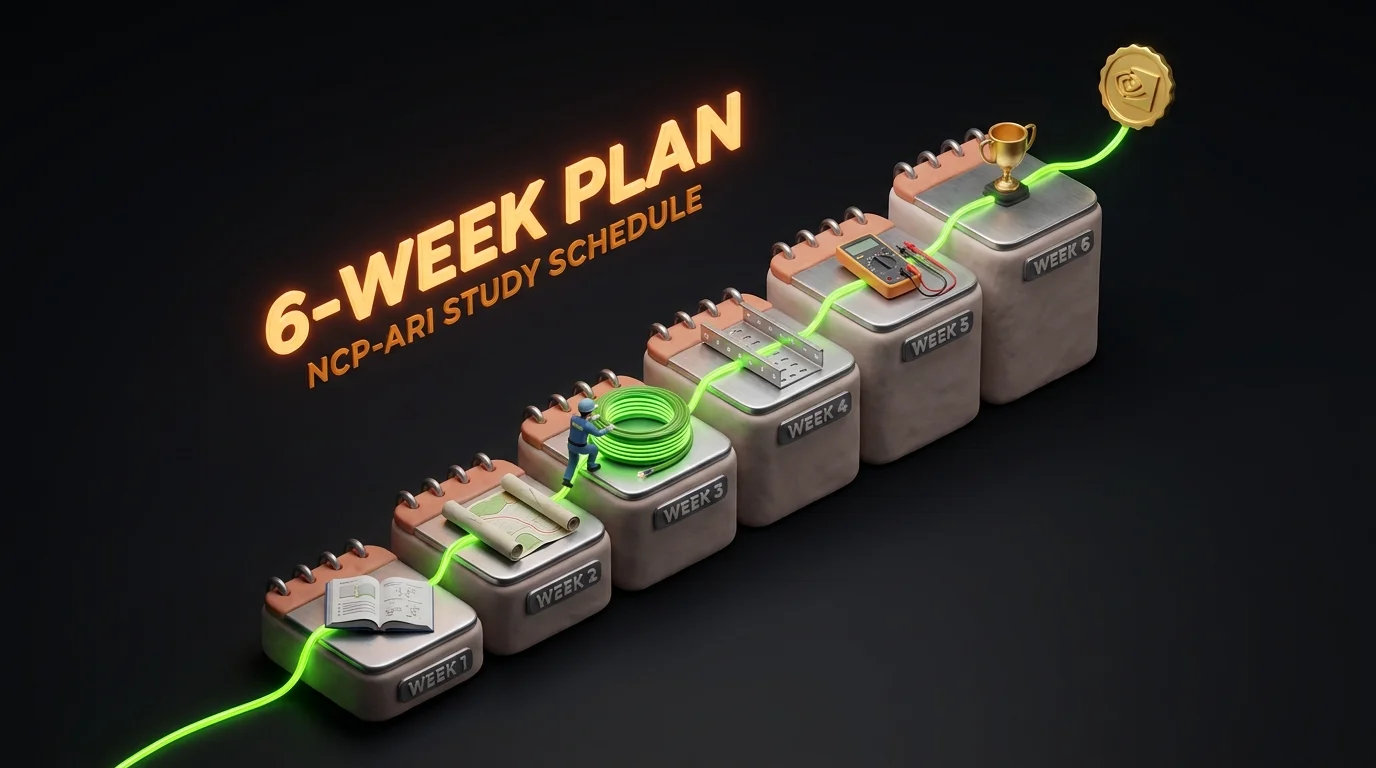
The NCP-ARI exam (NVIDIA-Certified Professional: AI Rack and Interconnect) tests trade knowledge: how to assess a site, prepare a rack, install thousands of high-speed links, and prove they all work. You answer 70 questions in 120 minutes, online proctored through Certiverse, and the heaviest domain by far is High-Density Cabling Installation at 30% of the exam. A study plan for this certification therefore has to behave differently from a software cert schedule. Instead of spinning up cloud labs, you build fluency with spec sheets, reference architectures, routing diagrams, and documentation exercises, because the exam grades whether you can think like a technician standing in front of an unbuilt DGX SuperPOD row.
Six weeks at 8 to 10 hours per week fits someone who already works in a data center. Exam logistics and registration details live in the complete NCP-ARI guide, and the per-domain topic depth is in the domains breakdown, which every week below references.
Find out where you stand first
Take the free NCP-ARI sample questions cold (no signup, real exam style), then read on with your gaps in mind. When you are ready for full rehearsal, Preporato's NCP-ARI practice tests include 7 full-length exams (490 questions in total, domain-proportional, every answer explained) for a one-time $19.99 with lifetime access.
Exam Quick Facts
Who This Plan Fits
NVIDIA recommends 2 or more years of enterprise data center operations experience for this exam, and the schedule below assumes roughly that profile. Run a quick self-check before committing to the 6-week pace. You are the target candidate if most of these are true:
- You have racked, cabled, and decommissioned servers or network gear in a production facility.
- You can explain hot and cold aisle containment (the practice of physically separating server intake air from exhaust air) and have worked inside it.
- You know the difference between multimode and single-mode fiber and have handled transceivers.
- You have followed a method of procedure, a permit process, or a similar controlled-work discipline on a live floor.
- You are comfortable reading electrical and mechanical spec sheets.
If you checked four or five, the 6-week plan fits as written. If you are a working data center technician who already handles high-density or supercomputing infrastructure, the compressed 3-week track near the end of this article will serve you better. If you come from general IT (helpdesk, sysadmin, or network roles without physical floor time), use the extended 8-week track instead, because weeks 1 and 2 assume vocabulary you will want extra time to absorb.
Why the first practice test waits until week 5
NCP-ARI is a new 2026 certification, and its core content (NDR/XDR cabling discipline, liquid-cooled rack preparation, busbar power) is new material even for experienced technicians. An early diagnostic would mostly measure vocabulary you have not met yet. This plan teaches first and saves full-length timed tests for weeks 5 and 6, when a score actually tells you something.
Day-one benchmark: answer these three NCP-ARI questions cold, then note which domain tripped you up. That domain gets extra time in the plan below.
Three quick NCP-ARI questions
A 40-cable inter-rack bundle leaves the overhead pathway and drops toward an NVL72 network rack. The installer has anchored it at the tray exit and at the rack entry, 3.5 m apart, and the span between sags visibly under its own weight. What does NVIDIA's cabling guidance require for this section of the run?
Preparing for NCP-ARI? Practice with 455+ exam questions
The Schedule
AI Infrastructure Foundations
Week 1- •Read the domains breakdown end to end
- •Study why AI racks differ: power density, liquid cooling, fabric cabling volume
- •Learn the DGX SuperPOD building blocks and the scalable unit concept
- •Build a media glossary: NDR, XDR, DAC, ACC, MPO, APC
Site Assessment and Rack Prep
Week 2- •Study site surveys: floor load capacity, rack clearances, delivery paths
- •Cover power and cooling readiness checks
- •Learn liquid cooling manifolds, quick disconnects, and airflow boundary zones
- •Understand DC busbar power delivery and extra-wide AI racks
Cabling Core: Media and Handling
Week 3- •Drill NDR and XDR link types and reach limits
- •Compare DAC, ACC, and fiber for each link class
- •Study MPO/APC connector handling and cleanliness practice
- •Memorize the 30 mm bend radius rule and the physics behind it
Cabling Core: Routing and Weight
Week 4- •Master the 50/50 left-right routing strategy
- •Study bundling, dressing, and layering order
- •Cover cable trays, supports, and weight management
- •Practice labeling schemes and port-map documentation
Testing, Safety, and First Full Test
Week 5- •Complete the free Cable Validation Tool (CVT) Fundamentals course
- •Study link validation workflow and as-built documentation
- •Review electrical, mechanical, and liquid handling safety
- •Take the first full-length timed practice test
Rehearsal and Exam
Week 6- •Timed practice tests every other day
- •Drill the two weakest domains between tests
- •Keep a daily error log sorted by domain
- •Verify Certiverse setup and sit the exam
Week-by-Week in Detail
Week 1: Why AI Racks Are a Different Trade
Spend the first week building the mental model that the AI Infrastructure Basics domain (20% of the exam) tests directly. A traditional enterprise rack draws single-digit kilowatts and cools itself with airflow alone. A DGX-class AI rack can draw an order of magnitude more power, which is why direct liquid cooling (circulating coolant through cold plates mounted on the hottest components) becomes mandatory rather than optional, and why the power chain moves from individual server cords toward rack-level DC distribution. On top of that sits the fabric: every GPU node carries multiple high-speed ports into an InfiniBand network (a switched, low-latency fabric that lets GPUs in different chassis exchange data as if they shared one machine), so the cable count per rack multiplies far beyond anything in classic server rows.
Learn the DGX SuperPOD structure this week: how compute nodes group into a scalable unit, how scalable units share fabric switches, and where management and storage networks run alongside the compute fabric. Close the week by writing your own glossary of the media terms you will drill later: NDR (the 400 gigabit per second InfiniBand generation), XDR (the 800 gigabit per second generation that follows it), DAC (direct attach copper, a passive copper cable with fixed transceiver ends), ACC (active copper cable, which adds signal-conditioning electronics to extend copper reach), MPO (multi-fiber push-on, a connector that terminates many fiber strands in a single ferrule), and APC (angled physical contact, an 8-degree polished fiber end face that reduces reflected light on the link).
No-SuperPOD drill: download the public DGX SuperPOD reference architecture documentation and sketch one scalable unit from memory: nodes per rack, switches, and the link count between them. Counting links by hand is the fastest way to internalize why cabling is 30% of this exam.
Week 2: Site Assessment and Rack Preparation
Week 2 covers two adjacent domains worth a combined 21%: Pre-Deployment Planning and Site Assessment (11%) and Rack Infrastructure Preparation (10%). Study the site survey as a structured checklist rather than a walkthrough. Floor load capacity comes first, because a fully populated, liquid-cooled AI rack concentrates weight that many raised floors were never rated for, and the survey has to confirm both the standing load and the rolling load along the delivery path. Then come rack clearances (AI racks run extra-wide to fit manifolds and cable channels), doorway and elevator dimensions, and the readiness of power and cooling feeds before any hardware ships.
On the rack preparation side, learn the liquid cooling interconnects in order: the manifold (the distribution pipe assembly running the height of the rack) feeds each node through quick disconnects, and the whole loop has to be staged and leak-checked before compute arrives. Study DC busbar power delivery the same way: a busbar is a rigid copper conductor mounted in the rack that distributes direct current to every node through blind-mate connections, which removes the per-server power cords that would otherwise compete with data cabling for space. Finish with containment and airflow boundary zones, because a liquid-cooled rack still moves air for some components and the boundary between cold and hot zones must survive all the penetrations your cabling will make.
No-SuperPOD drill: write a one-page mock site assessment for an imaginary colocation hall. Invent plausible numbers, then judge them: floor rating, clearances, delivery path, available power, cooling type. The documentation habit pays off twice, since Testing, Verification, and Documentation is its own scored domain.
Weeks 3 and 4: The Cabling Core
High-Density Cabling Installation is 30% of the exam, so it gets two full weeks. Week 3 is about media and handling. For every link class in the fabric, you should be able to choose the right cable: DAC for the shortest runs where passive copper is cheapest and adds no electronics to fail, ACC where copper needs a few more meters of reach, and MPO/APC fiber for everything longer. Learn the reach limits from the spec sheets rather than memorizing a table blind, because scenario questions describe distances and ask for the correct medium. Then drill handling discipline: fiber end-face cleanliness (a single dust particle on an MPO ferrule can degrade a link), connector orientation, and above all the 30 mm bend radius rule. Glass attenuates and can microfracture when bent tighter than its rated radius, and a violation buried in the middle of a dressed bundle is one of the most expensive faults to find later.
Week 4 turns to routing at scale, which is where AI cabling stops resembling ordinary structured cabling. Study the 50/50 left-right routing strategy: each rack splits its cable plant evenly between the left and right vertical channels, so that no single channel exceeds its density and weight limits, airflow boundaries stay intact, and technicians retain service access to every port. Learn the layering order for bundling and dressing (which cable groups go down first and which dress over them), because ultra-high-density racks are cabled in planned layers and an out-of-order bundle can force a partial teardown. Then give the smallest domain its due: Cable Support Systems and Weight Management (7%) exists because the cable plant of a dense AI row weighs hundreds of kilograms, and unsupported bundles sag, strain connectors, and produce the intermittent link errors that surface weeks after handover.
A tactile anchor for bend radius
You do not need lab access to build feel for the 30 mm rule. Any spare fiber patch cable and a soda can will do: the curve of the can is close to the tightest legal bend. Route the cable around household corners and notice how easily a natural-looking path violates the radius. That intuition answers exam scenarios faster than a memorized number.
No-SuperPOD drills: in week 3, run a media selection exercise by writing down ten link scenarios with distances and picking DAC, ACC, or fiber for each, checking your choices against transceiver spec sheets. In week 4, draw a full routing plan for one rack: assign every port to a left or right channel under the 50/50 rule, then estimate total bundle weight using per-meter cable mass from the spec sheets. This single diagram exercises the top domain and the weight domain together.
Week 5: Testing, Safety, and the First Full Practice Test
Week 5 closes the remaining domains. Start with the free self-paced Cable Validation Tool (CVT) Fundamentals course, which is the one official hands-on resource for this exam. CVT is NVIDIA software that compares every installed link against the intended cluster topology and flags miscabled ports and degraded links, and the Testing, Verification, and Documentation domain (12%) leans on its workflow: validate, correct, revalidate, and record. Pair the course with a documentation exercise: draft an as-built template (the record of what was actually installed, port by port, as opposed to what the design called for) and fill it in for the rack routing plan you drew in week 4.
Then cover Safety, Standards, and Compliance (10%). Think in three hazard categories: electrical (busbar power distribution carries serious current, and work near it follows strict procedures), mechanical (fabric switches and cable bundles are heavy, often installed at height, and lifting and securing them safely is tested knowledge), and liquid (coolant connections get leak-checked and handled with controlled procedures). Study these as the reasoning behind each rule rather than a list to memorize, because the questions describe situations and ask what a compliant technician does next.
End the week with your first full-length timed practice test. Preporato publishes 7 full-length NCP-ARI practice tests (70 questions each, 490 in total) built on the exact 7-domain blueprint and framed around a greenfield DGX SuperPOD build, with an explanation for every answer. Take test 1 under exam timing, then spend a full session reading explanations, including the questions you got right.
Week 6: Rehearsal, Weak Domains, and Logistics
The final week converts knowledge into exam pace. Alternate days: a timed 70-question practice test one day, then a drilling day focused on your two weakest domains the next. Keep an error log with three columns (domain, concept, why the correct answer wins), and review it for 15 minutes daily. Because NVIDIA does not publish the passing score, calibrate against consistency instead: three consecutive timed tests at 75% or better, with no single domain collapsing, is a sound green light.
Handle logistics early in the week. The exam runs online proctored through Certiverse, so verify your machine, camera, and network in advance, prepare identification, and clear a private room for the 120-minute window. Question-level tactics (flag-and-return strategy, pacing checkpoints, elimination on scenario questions) are covered in the first-attempt guide, and the one-page cheat sheet is built for the final 48 hours of review.
Weekly Rhythm
- Two weeknight sessions (2 hours each): domain study, each closed by writing five self-test questions on the material you just covered
- One weekend block (3 to 4 hours): the week's no-SuperPOD drill plus review of the previous week's notes
- Daily 15 minutes: glossary and error-log review
Master These Concepts with Practice
Our NCP-ARI practice bundle includes:
- 7 full practice exams (455+ questions)
- Detailed explanations for every answer
- Domain-by-domain performance tracking
30-day money-back guarantee
If Six Weeks Is the Wrong Size
The 3-Week Compressed Track (working data center technicians)
If you stage and cable hardware for a living, compress the plan to three weeks at 12 to 15 hours per week. Merge weeks 1 and 2 into a single week that skims familiar ground (site surveys, containment) and concentrates on the AI-specific deltas: liquid cooling manifolds, DC busbar delivery, extra-wide racks, and SuperPOD fabric structure. Give week 2 entirely to the cabling core, including the routing plan drill, since NDR/XDR media rules and the 50/50 strategy will still be new even if your hands know cable dressing. Week 3 combines the CVT course, safety review, and four timed practice tests on alternating days.
The 8-Week Extended Track (career changers from general IT)
If your background is general IT without physical data center time, add two weeks at the front and keep the original order. Spend the new weeks 1 and 2 on data center fundamentals: the power chain from utility feed to rack, air cooling and hot and cold aisle containment, raised floor and slab construction, and basic fiber optics (multimode versus single-mode, connector types, what a transceiver does). Free vendor documentation and introductory data center courses cover all of it. Then run the standard six weeks as written, and consider stretching the cabling core to three weeks if the week 4 routing drill feels shaky. The exam assumes floor experience, so the extended track also benefits from any real-world exposure you can arrange, even a facility tour.
Frequently Asked Questions
Milestones
6-Week Plan Milestones
0/6 completedPut the Plan on a Calendar
A schedule only works once it has dates on it, so pick an exam day roughly seven weeks out, book it, and let the deadline pull the weeks forward. When you reach week 5, Preporato's NCP-ARI preparation gives you the full rehearsal bank this plan assumes: 7 timed practice tests on the official 7-domain blueprint with explanations that teach the trade reasoning behind every answer, available through Preporato Pro or the single-cert bundle.
Sources:
Last updated: August 8, 2026
Ready to Pass the NCP-ARI Exam?
Join thousands who passed with Preporato practice tests