
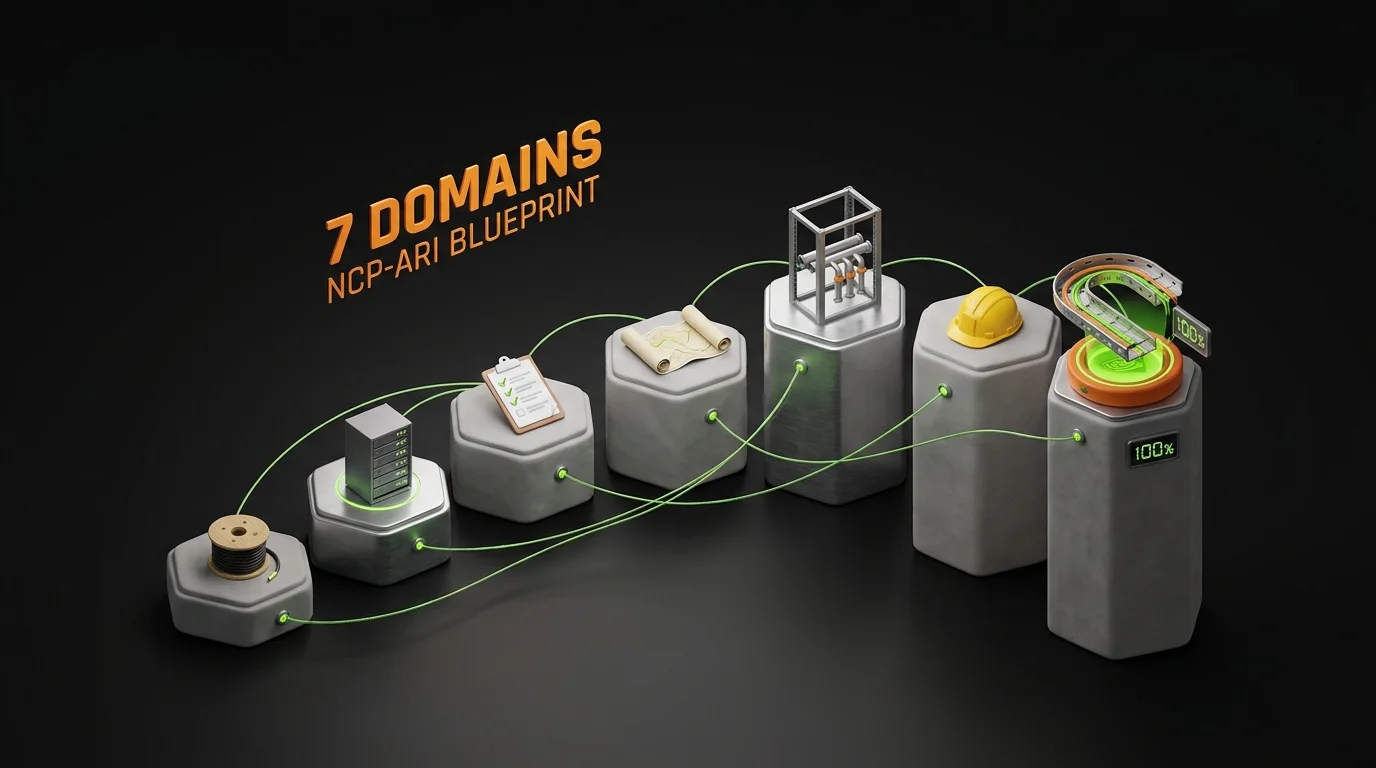
Half of the NCP-ARI exam is about cable. High-Density Cabling Installation carries 30% of the blueprint on its own, and once you add Testing, Verification, and Documentation at 12% and Cable Support Systems at 7%, the work of pulling, terminating, validating, and supporting cable plant accounts for 49 of the 100 weighting points. The other half covers the racks, power, cooling, the site itself, and the safety rules that keep a deployment crew intact. The weights mirror how a DGX SuperPOD deployment crew actually spends its days.
This article breaks down all seven domains topic by topic at exam depth, with the field scenarios the questions are built around. For exam logistics like cost, registration, and format, start with the complete NCP-ARI guide. For a week-by-week calendar that follows these weights, use the 6-week study plan.
Find out where you stand first
Take the free NCP-ARI sample questions cold (no signup, real exam style), then read on with your gaps in mind. When you are ready for full rehearsal, Preporato's NCP-ARI practice tests include 7 full-length exams (490 questions in total, domain-proportional, every answer explained) for a one-time $19.99 with lifetime access.
Exam Quick Facts
Read each domain twice
NCP-ARI is delivered as 70 multiple-choice questions, yet every domain describes physical work. Read each topic twice: once as a knowledge item and once as a procedure you could execute on the data center floor in the right order. The scenario questions grade the second reading.
How the 70 Questions Distribute
NVIDIA publishes weights without per-domain question counts, so the table applies each weight to the 70-question total. Treat the counts as planning estimates.
NCP-ARI Weight Distribution: Domain to Questions
| Domain | Weight | Estimated questions (of 70) |
|---|---|---|
| 1. High-Density Cabling Installation | 30% | ~21 |
| 2. AI Infrastructure Basics | 20% | ~14 |
| 3. Testing, Verification, and Documentation | 12% | ~8 |
| 4. Pre-Deployment Planning and Site Assessment | 11% | ~8 |
| 5. Rack Infrastructure Preparation | 10% | ~7 |
| 6. Safety, Standards, and Compliance | 10% | ~7 |
| 7. Cable Support Systems and Weight Management | 7% | ~5 |
Domains 1 and 2 together supply roughly 35 questions, half of the exam, so fluency in cabling and AI rack fundamentals largely decides the result. The four smallest domains still contribute about 27 questions combined, so skipping them quietly hands back your Domain 1 advantage.
Preparing for NCP-ARI? Practice with 455+ exam questions
How to Split Your Study Time
A proportional split is the right baseline: for every ten hours of study, spend about three on cabling, two on AI infrastructure basics, and roughly one on each of the remaining five domains. Then apply two corrections. Candidates from general data center operations who have never worked around GPU clusters should front-load Domain 2, because power density, liquid cooling, and fabric topology form the vocabulary every other domain assumes. Structured-cabling veterans who already dress fiber for a living should look instead at Domains 2, 5, and 6, where AI rack hardware behaves differently from the enterprise rows they know.
Measure the split instead of guessing it. Preporato's NCP-ARI practice tests follow this exact 7-domain blueprint with 7 full-length exams (490 scenario questions, every answer explained), and the per-domain score report shows where your next study block belongs.
Domain 1: High-Density Cabling Installation for AI Clusters (30%)
Core Topics
- •InfiniBand NDR and XDR copper links (DAC and ACC)
- •MPO/APC fiber optic connectivity
- •Bundling, routing, and dressing dense cabling layers
- •The 50/50 left-right routing strategy
- •30 mm bend radius constraints
Skills Tested
Example Question Topics
- A server must reach a leaf switch 2.5 meters away at NDR speed with minimal power draw. Which cable fits?
An AI cluster is one computer stretched across many racks, and InfiniBand is what stretches it: a low-latency network fabric that lets every GPU exchange data with every other GPU fast enough for them to train a single model together. Building that fabric means terminating thousands of links across a compute row, which is why this domain outweighs the next two combined.
The first skill is choosing the medium. DAC (direct attach copper) is a passive twinaxial copper cable with connector modules factory-terminated on each end; it is the cheapest and lowest-power option and works only over the shortest runs. ACC (active copper cable) adds signal-conditioning electronics inside the connector to push copper farther, which matters at NDR (the 400 gigabit per second InfiniBand generation) and XDR (the 800 gigabit generation), where passive reach shrinks. Beyond copper reach you move to optical transceivers and fiber terminated with MPO connectors (multi-fiber push-on, a single ferrule carrying many strands) polished as APC (angled physical contact, an eight-degree end-face angle that steers reflected light away from the transmitter). Exam questions hand you a distance, a speed, and a power or cost constraint, then ask which medium survives all three.
The second skill is routing under constraints. The signature rule is the 50/50 left-right routing strategy: split each rack's bundle evenly between the left and right vertical cable managers. The split balances weight on the rack frame, keeps both sides serviceable when a link needs replacing, and prevents the single-side congestion that forces technicians into tight bends. The tight bend is the enemy, because high-speed links tolerate a minimum bend radius of roughly 30 mm; curve a cable harder and the glass or twinax geometry deforms, insertion loss climbs, and the link starts throwing errors at 400 or 800 gigabits.
The rest of the domain is craft: dressing in layers so late bundles never crush early ones, labeling both ends before a bundle closes, leaving service loops above the radius limit, and sequencing the densest layers first. The exam treats these as testable procedure, because on a SuperPOD build a sloppy first layer becomes a rework bill measured in weeks.
Domain 2: AI Infrastructure Basics for Data Centers (20%)
This domain explains why the job exists. An AI rack draws many times the power of a traditional enterprise rack, and that power density is the reason air cooling gives out and liquid cooling (circulating coolant through cold plates mounted directly on the hottest chips) becomes standard equipment. Power density also drives weight, cable count, and the extra-wide rack formats of Domain 5, so these concepts are load-bearing for the whole blueprint.
The fabric side covers topology: the map of which port connects to which. AI deployments separate traffic onto distinct networks: a compute fabric for GPU-to-GPU traffic, a storage fabric, and a management network, with the compute fabric typically built as a multi-tier tree. As the installer you execute that topology physically, and the exam expects you to read a topology drawing and translate it into which cable leaves which port and lands where.
The building blocks supply the vocabulary. DGX is NVIDIA's line of GPU server appliances, and a DGX SuperPOD is the validated reference architecture that combines DGX systems, the InfiniBand fabric, and storage into repeatable units that scale by copying the unit. When a statement of work says SuperPOD, the rack layout, switch counts, and cable runs are already specified, and your job is faithful execution.
Candidates from facilities work should give this domain extra time, because it is the scaffolding under everything else. It also marks the boundary with neighboring NVIDIA certifications: NCP-AII covers the software and deployment layer that runs on the hardware you install, and NCP-AIN covers configuring and operating the fabric you cable.
Domain 3: Testing, Verification, and Documentation (12%)
On a fabric with thousands of links, small error rates hide well. A cluster can pass casual inspection while carrying dozens of marginal links that surface months later as training jobs running mysteriously slow. This domain exists so degradation gets caught while the crew is still on site. The basics are link validation metrics: whether each link negotiates its full speed and width, and whether its bit error rate (the fraction of transmitted bits that arrive corrupted) sits inside specification.
The tool at the center is the NVIDIA Cable Validation Tool (CVT), software that discovers the cabling as actually installed and checks it against the intended topology, flagging links that are missing, landed on the wrong port, or negotiating below rated speed. The free self-paced CVT Fundamentals course is the most directly examinable official resource for this domain.
Here is a field scenario the exam draws from. CVT flags one NDR link as degraded: it comes up, but at reduced speed with an elevated error rate. Swapping transceivers changes nothing, so the technician traces the run and finds the fiber cinched into a bend tighter than 30 mm where a tie pulled it hard against a tray exit. Re-dressing and re-testing clears the fault. Validation failures usually decode to installation quality, and the exam expects you to walk that diagnostic chain from software finding to physical cause.
The domain closes with as-built documentation: the record of what was actually installed, including every point where reality diverged from design. Port maps, cable identifiers, serials, and test results belong in it, because the team that inherits the cluster will troubleshoot from your documents for years.
Domain 4: Pre-Deployment Planning and Site Assessment (11%)
Site assessment earns its own domain because its failures are the most expensive kind: they surface after the hardware ships. A survey verifies four things before anything arrives. Floor load capacity means confirming the slab or raised floor can carry the racks, checked as distributed load across the row and point load under each caster. Clearances cover aisle widths, door and ramp dimensions, and the full delivery path from the loading dock. Power readiness covers feeds, breaker capacity, and receptacles matching the rack PDUs (power distribution units, the rack-mounted strips that feed the equipment). Cooling readiness asks whether the facility can reject the heat the new row will produce.
The classic save looks like this. A survey for a colocation retrofit finds the raised floor rated well below the weight of the incoming liquid-cooled racks, which approach three tons each once loaded with equipment and coolant. Because the survey ran weeks ahead of delivery, the fix becomes a planning line item: reinforce the floor grid, add load-spreading plates, or move the row onto slab. Discovered on delivery day, the same fact strands the racks on the dock and cascades into rebooked crews and missed handover dates.
Exam questions here read like survey findings and ask for the correct disposition: which finding blocks delivery, which requires remediation before power-on, and which is a note for the record. Readiness checks also have an order (floor before racks, power before energization, cooling before load testing), so practice thinking in sequence.
Master These Concepts with Practice
Our NCP-ARI practice bundle includes:
- 7 full practice exams (455+ questions)
- Detailed explanations for every answer
- Domain-by-domain performance tracking
30-day money-back guarantee
Domain 5: Rack Infrastructure Preparation for AI Platforms (10%)
AI platforms ship in extra-wide rack formats because the rack now carries plumbing and power busbars alongside the IT gear. This domain covers preparing that rack before compute arrives. Containment comes first: horizontal and vertical containment panels, blanking plates, and brush strips establish airflow boundary zones so the air-cooled components in a mostly liquid-cooled row still draw cold air at the intake and exhaust where the facility expects. A missing blanking panel recirculates hot air and raises intake temperatures across every neighbor.
Liquid cooling reaches the rack through manifolds: vertical supply and return pipe assemblies that distribute coolant to a quick-disconnect (a dripless coupling built to connect and separate without spilling) at every equipment position. Sequencing is the examinable skill. Manifolds are mounted, connected to the facility loop, and pressure-tested for leaks before compute trays install and before any cable is dressed, because a leak found after the bundles are finished means tearing out completed work to reach one fitting. Plumbing verification gates everything downstream.
Power delivery inside these racks increasingly uses a DC busbar, a rigid copper bar running down the rear of the rack that equipment trays blind-mate into, replacing the per-server power cords of a traditional build. For the installer that rewrites the checklist: torque specs on busbar joints, insulating covers before energization, and a strict order for when the bar may go live relative to tray installation.
Domain 6: Safety, Standards, and Compliance for Data Centers (10%)
The energies on an AI build are unforgiving: switch chassis and compute trays heavy enough to injure, high-current DC behind thin covers, pressurized coolant loops, and overhead work from ladders and lifts. Electrical safety centers on lockout/tagout (isolating a power source, physically locking it out, and verifying zero energy before touching anything it feeds) and on treating a busbar as live until proven otherwise. Mechanical safety covers team-lift thresholds, lift equipment for heavy chassis, and safe work at height.
Standards adherence rounds out the domain: installing to manufacturer specifications (torque values, bend radius, tray fill limits) and site installation standards, then keeping the paper trail that proves it. The exam frames these as scenarios with one compliant answer among efficient-looking shortcuts, and the compliant sequence wins every time.
Weight this domain by consequence as much as by percentage. Seven questions ride on it, and on the floor these procedures separate a completed build from an incident report.
Domain 7: Cable Support Systems and Weight Management (7%)
The smallest domain covers a physical reality that surprises newcomers: cable plant at this density is heavy. NDR-class copper is thick, and thousands of runs concentrated into overhead pathways add up to loads that bend inadequate hardware. It covers the support systems (ladder rack and basket tray overhead, vertical managers at the rack) and the sizing rules: support spacing tight enough that spans never sag, and fill ratios (the fraction of a tray cross-section that cable may occupy) that keep the bottom layer from being crushed.
At the rack, weight management means strain relief. Bundles are anchored so their weight hangs on the support structure and never on the connector interfaces, because a transceiver dragged downward by a few kilograms of bundle develops exactly the marginal, intermittent faults Domain 3 teaches you to chase. A sagging span or a loaded connector is the standard wrong-answer picture in this domain.
The small domain closes the loop with the big one: the 50/50 routing split from Domain 1 is also a weight decision, and the tray you size here is what keeps every bend radius upstream intact. At 7%, this is the cheapest ground on the exam to secure.
Working the Blueprint
Study the domains in weight order, and rehearse them as procedures in build order: survey the site (Domain 4), prepare the rack (Domain 5), install the cabling on its supports (Domains 1 and 7), then validate and document (Domain 3), with infrastructure knowledge (Domain 2) and safety (Domain 6) running through every step. When you can narrate a greenfield SuperPOD build end to end in that order, the blueprint belongs to you. Review with the NCP-ARI cheat sheet and finish with the first-attempt guide.
Frequently Asked Questions
Before You Book: Domain Mastery Checklist
NCP-ARI Domain Mastery Checklist
0/9 completedSources:
Last updated: August 8, 2026
Ready to Pass the NCP-ARI Exam?
Join thousands who passed with Preporato practice tests