
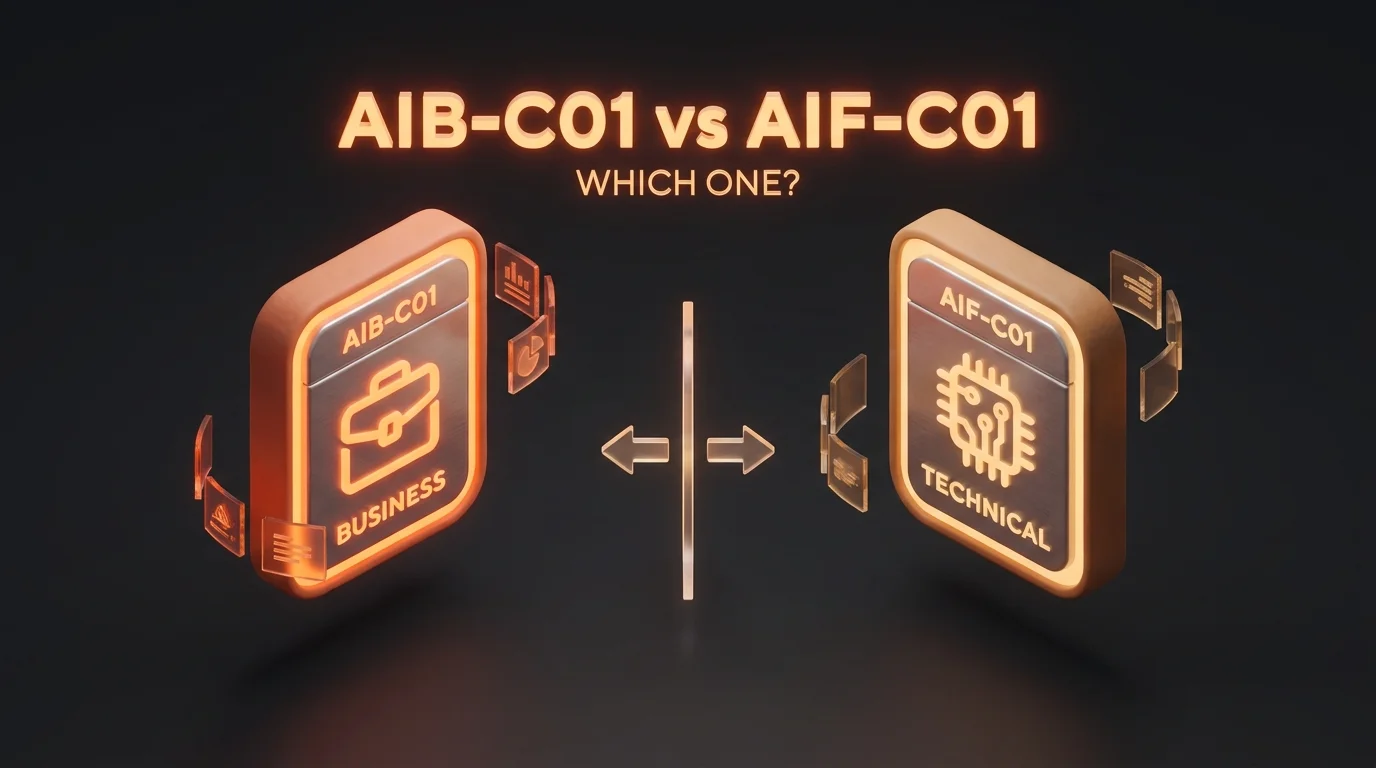
AWS now has two AI certifications with no prerequisites and no coding requirement. They look interchangeable from the outside and they are not. One tests whether you understand AI and the AWS services that deliver it. The other tests whether you can decide which AI initiatives an organization should fund, how to prove they worked, and how to govern them.
Picking the wrong one wastes a few weeks and a hundred dollars. Picking the right one depends almost entirely on what your job actually is.
AIB-C01 and AIF-C01 side by side
| AI Business Strategist (AIB-C01) | AI Practitioner (AIF-C01) | |
|---|---|---|
| Category | Business | Foundational |
| Core question | Should we do this, and how do we govern it? | What is this, and which AWS service does it? |
| Coding required | None | None |
| Prerequisites | None | None |
| Cost | $100 (beta $50) | $100 |
| Duration | 130 minutes (beta form 170) | 90 minutes |
| Passing score | 700 of 1,000 | 700 of 1,000 |
| Recommended experience | ~6 months working with or alongside AI adoption | ~6 months exposure to AI/ML technologies on AWS |
| AWS service depth | Strategic awareness only | Broader service coverage and use-case matching |
| Typical roles | Product and program managers, consultants, sales, line-of-business leaders, analysts | Anyone needing AI literacy: developers, sales, marketing, IT, students |
| Launched | Beta 29 September 2026 | 2024 |
The clearest difference
Both exams will ask you about retrieval-augmented generation. The way they ask is what separates them.
AIF-C01 asks what RAG is and when it applies: a technique that supplies a model with retrieved documents so answers reflect current source material rather than training data alone.
AIB-C01 asks what you should do about it. An HR assistant is giving outdated answers about a benefits policy that changed last month. Policy documents live in the company library and change several times a year. Do you fine-tune on each revision, use retrieval, put the whole handbook in every prompt, or replace the assistant with a search page? All four are things organizations actually do. One of them fits the stated constraint.
That is the pattern across every domain. AIF-C01 tests recognition. AIB-C01 tests judgment under constraints.
A quick self-test
Read this and decide which exam it belongs to:
A utility processes 4,000 rebate applications a month against three published eligibility criteria. Applicants upload a photographed receipt. A vendor proposes a generative AI application to decide eligibility. What do you recommend?
If your instinct was to work out which AWS service handles document extraction, you are thinking like an AIF-C01 candidate. If your instinct was that a rules engine should decide eligibility and AI should only read the receipt, you are thinking like an AIB-C01 candidate. Both instincts are useful. Only one is the exam.
Try 15 AIB-C01 practice questions free
They come from the AIB-C01 practice tests, and each option shows its explanation once you answer.
- 6 timed practice exams
- Every answer explained
- A score for each domain
- $19.99 one-time
Domain comparison
AIF-C01 covers five domains:
AIF-C01 domains
| Domain | Weight |
|---|---|
| Fundamentals of AI and ML | 20% |
| Fundamentals of GenAI | 24% |
| Applications of Foundation Models | 28% |
| Guidelines for Responsible AI | 14% |
| Security, Compliance, and Governance for AI Solutions | 14% |
Note that AIF-C01's exam guide was refreshed for 2026. It now covers agentic AI, the Model Context Protocol, multi-agent patterns, memory management, context engineering, prompt caching and model distillation, alongside newer AWS offerings including Amazon Bedrock AgentCore, Amazon Nova, Amazon Quick, Kiro and Strands Agents. Study material written for the 2024 launch omits all of it.
AIB-C01 covers four domains with no dominant section:
AIB-C01 domains
| Domain | Weight | What it tests |
|---|---|---|
| AI Fundamentals and Literacy | 24% | Concepts in business terms, data types and quality, rules vs AI, agents, drift, prompt engineering, RAG and fine-tuning, ISO/IEC 23053 and 42001 |
| AI Strategy and Business Value Creation | 28% | Use case identification, build-buy-partner, prioritization, when AI is not the answer, KPIs and baselines, ROI frameworks, cost control, competitive positioning |
| AI Governance and Responsible AI Leadership | 24% | Responsible AI dimensions and tradeoffs, governance by design, human oversight and guardrails, governance structures, regulatory compliance, risk classification, bias and IP |
| Business Readiness, Leadership, and AI Transformation | 24% | Readiness and maturity assessment, capability gaps, data foundations, sponsorship and champions, workforce change, scaling from pilot to enterprise |
Only Domain 1 overlaps meaningfully with AIF-C01, and even there the framing differs. AIF-C01 wants you to know what model drift is. AIB-C01 gives you a fraud model whose accuracy was validated at launch, reports more false negatives fourteen months later with no code changes, and asks what the bank should do.
The AWS service surface
This is where candidates most often misjudge the preparation required.
AIF-C01 has a broad service surface. Bedrock, SageMaker, Comprehend, Rekognition, Textract, Transcribe, Polly, Translate, Kendra, Q, and more, with an expectation that you can match a service to a use case.
AIB-C01 has a deliberately small one. The in-scope list is Amazon Bedrock, Amazon SageMaker AI, and Amazon Quick for AI and business intelligence, plus AWS Cloud Adoption Framework, the shared responsibility model, and the cost tools: AWS Pricing Calculator, AWS Cost Explorer, and AWS Marketplace. Everything is tested at a business level.
A representative AIB-C01 question gives three needs and asks which service fits each. A generative assistant answering from company documents is Bedrock. A custom forecasting model on twelve years of proprietary order data is SageMaker AI. Letting non-technical managers ask questions of sales data and get charts back is Amazon Quick. You will not be asked to configure any of them.
If you already hold AIF-C01
You have most of Domain 1 and part of Domain 3 already. What you do not have is Domain 2 and Domain 4, which together are 52 percent of the exam and cover material that appears nowhere on AIF-C01: ROI frameworks, baseline metrics, build-buy-partner decisions, maturity models, capability gap analysis, change management and enterprise scaling.
Budget your preparation accordingly. Holding AIF-C01 does not make AIB-C01 a formality.
Which one should you take?
Take AIB-C01 if you evaluate, champion or fund AI initiatives, sit in product, program, consulting, sales, marketing or line-of-business leadership, need to build business cases or govern AI adoption, or work alongside technical teams without building solutions yourself.
Take AIF-C01 if you need broad AI literacy and AWS service awareness, work in or adjacent to technical delivery, want a foundation before a technical AI certification, or need to match AWS AI services to use cases in your day job.
Take both if you sit at the boundary. Consultants and solution-selling roles frequently need the service breadth of AIF-C01 and the strategic framing of AIB-C01. They complement rather than duplicate.
Sequencing if you want both
Take AIF-C01 first if you are unsure of your AI fundamentals. Its Domain 1 and Domain 2 material carries directly into AIB-C01's Domain 1, and the broader service exposure is useful context for AIB-C01's strategic questions.
Take AIB-C01 first if your fundamentals are solid and your job is about decisions rather than delivery. There is nothing in AIF-C01 that AIB-C01 depends on, and the beta pricing plus Early Adopter badge only apply until 15 February 2027.
Three questions from the AIB-C01 practice tests
A grocery chain's board has approved an ambitious AI agenda. The technology function reports that cloud infrastructure and data platforms are in place and that two data science teams are hired. The strategist has been asked to assess readiness before initiatives are launched, and finds that no executive owns the agenda, store managers have not been consulted, and there is no process for approving an AI system for use. What should the readiness assessment conclude?
Readiness spans leadership alignment, data, culture, technical infrastructure, and governance. Two of those are strong here and three are absent, which is the common pattern in organizations that approach AI as a technology program. Naming the specific gaps is what turns an assessment into a plan rather than a verdict.
A. Infrastructure and talent are genuine prerequisites and the chain has done real work to secure them. Readiness is assessed across several dimensions, and programs that have only the technical ones tend to produce working models that never enter daily operations.
B. Use case specifics do refine what each initiative needs and later assessments should be sharper. Organizational readiness dimensions such as executive ownership and an approval process apply across the portfolio, and waiting for use cases means discovering the gaps after commitments are made.
C. Data quality is a central readiness dimension and it does deserve assessment before initiatives commit to accuracy targets. Treating one unassessed dimension as blocking any conclusion stalls the assessment, when the more useful output is a picture of strengths and gaps across all dimensions.
An insurance company wants to use AI to speed up claims triage. The data team reports that roughly 40 percent of claim records have a blank incident type field, and the free text adjuster notes use inconsistent abbreviations across three legacy systems that were merged after an acquisition. The program manager is preparing the business case for the steering committee. What is the most accurate business implication to present?
Model quality is bounded by data quality. A triage model trained on records where the incident type is missing four times out of ten will make weaker distinctions on exactly the field the business cares about. Putting remediation in the plan up front is what keeps the accuracy commitments credible.
A. Remediation carries cost and schedule, both of which sit in the business case. It also affects the achievable accuracy, which drives the benefit side of the return calculation. Treating it as purely technical is how AI programs commit to targets they cannot reach.
B. Volume helps, but a large volume of records with a missing key field does not supply the signal a triage model needs. Scale and quality are separate dimensions, and adding more records with the same gaps reproduces the gaps at scale rather than diluting them.
D. Unstructured data is harder to prepare but it is frequently the most valuable source in a claims workload, because adjusters record context that never reaches a form field. Modern extraction and language models are built for this data. The inconsistent abbreviations are a preparation task, not a reason to discard the source.
A retail chain is reviewing three initiatives at a leadership meeting. The first is a demand forecasting system trained on five years of store sales history. The second is an assistant that drafts product descriptions from a short brief. The third is a rules engine that routes any refund under 50 USD for automatic approval. The chief operating officer asks which of the three is generative AI. Which response is correct?
Generative AI produces new artifacts such as text, images, audio, or code in response to a prompt. That is the distinguishing property, and the product description assistant is the only one of the three that does it. The other two either predict a value or apply fixed rules.
B. Only two of the three use models at all, and the rules engine encodes published thresholds rather than learned patterns. Treating every automated system as AI blurs a distinction that matters for budgeting, governance, and risk classification, because rule-based systems carry a different oversight profile.
C. Automation and AI are not the same thing. The refund router applies a fixed published threshold, which is deterministic rule-based logic. Removing a human from a step does not make the step generative AI, and this system does not learn from data at all.
D. Forecasting is a predictive machine learning workload. It scores or estimates a value from patterns in historical data, and the output is a number rather than new content. Being trained on historical data is a property of machine learning generally, so it does not identify the initiative as generative.
Full AIB-C01 set: 6 timed exams, every answer explained, $19.99 one-time.
See the practice testsWhich is harder?
They are hard in different ways, which makes a single answer misleading.
AIF-C01 is harder to prepare for in breadth. There are more services, more terminology, and more surface area to cover, and the questions reward recall.
AIB-C01 is harder to prepare for in depth. The surface area is small and the questions are long, scenario-based, and populated with options that all sound reasonable. Candidates report that the reading load is the constraint, not the knowledge.
The failure modes differ too. People fail AIF-C01 by not knowing a service. People fail AIB-C01 by choosing the technically impressive answer when the scenario called for a process fix, a rules engine, or a decision that AI is not the right tool at all.
Cost and timing
Both cost $100 at standard pricing. AIB-C01 is $50 during the beta, which runs from 29 September 2026, and candidates certified by 15 February 2027 receive an Early Adopter badge.
If you are choosing between them and could plausibly take either, the beta window is a genuine reason to take AIB-C01 first. Half price and a badge that will never be available again is a real, if temporary, argument.
Frequently asked questions
Next step
If AIB-C01 is the right exam for you, the fastest way to find out whether you are ready is to sit scenarios rather than read summaries. Preporato's AIB-C01 practice tests run at the official domain weights with an explanation on every option. Start with the free AIB-C01 sample questions.
If AIF-C01 is the better fit, our AIF-C01 practice tests are written against the current exam guide including the agentic AI additions, and include all four exam question types: multiple choice, multiple response, ordering and matching. The free AIF-C01 sample questions is the quickest way to check your level.