
AWS Certified Generative AI Developer - Professional course
5 modules, one per exam domain. 146 lessons, each ending in a checkpoint; 7 timed practice tests.
One purchase covers the lessons and the tests.
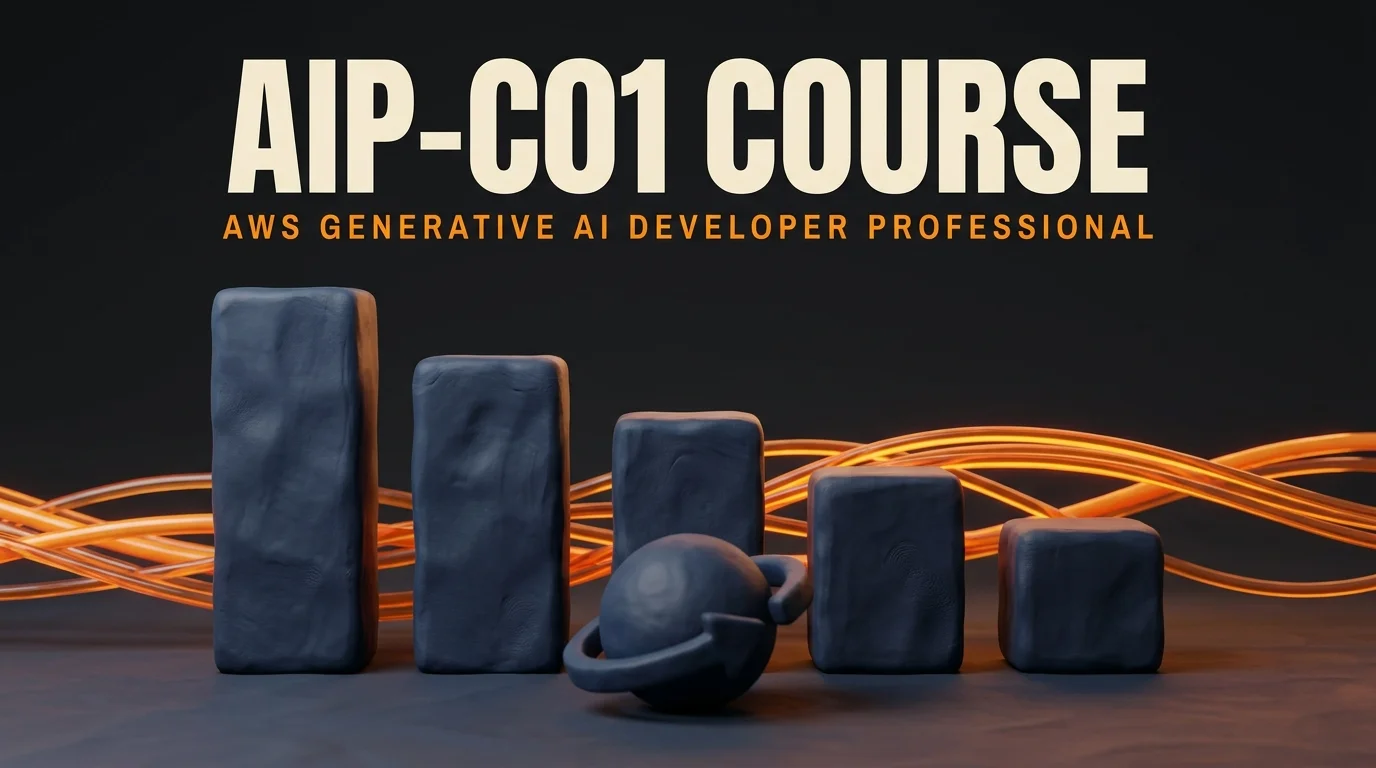
What does the AIP‑C01 course cover?
Every module is one of the 5 exam domains Amazon Web Services (AWS) publishes, in exam order, with the domain's share of the exam as its bar. Foundation Model Integration, Data Management, and Compliance and Implementation and Integration carry the most at 31% and 26%. The exam runs 180 minutes for 75 questions (65 scored + 10 unscored). Open a module for its lessons; the practice tests close the course.
Learn to design GenAI solutions, select and configure foundation models, build RAG architectures, and master prompt engineering
31% of the exam
GenAI Solution Design and Architecture
Architectural fundamentals, use case analysis, and integration patterns for GenAI
- 1.1
GenAI Architecture Fundamentals
Foundation models vs traditional ML · Inference vs training architectures · Synchronous vs asynchronous processing · Stateless application design for GenAI · Context management strategies
45 minHigh priority
- 1.2
Foundation Model Capabilities and Limitations
Token limits and context windows · Model strengths by task type · Hallucination risks and mitigation · Latency and throughput considerations · Multi-modal capabilities
40 minHigh priority
- 1.3
Use Case Analysis and FM Selection Criteria
Matching models to business requirements · Performance benchmarks evaluation · Cost-capability tradeoff analysis · Regulatory and compliance requirements · Model availability and support
35 minHigh priority
- 1.4
Proof-of-Concept Design and Validation
Rapid prototyping with Bedrock · Validation metrics definition · A/B testing for model selection · Business value demonstration · Scaling from POC to production
30 minCore topic
- 1.5
Integration Patterns for Enterprise Applications
API-first integration approach · Event-driven GenAI architectures · Microservices with FM integration · Legacy system integration · Error handling and fallback strategies
35 minHigh priority
- 1.6
Multi-Modal Architecture Design
Text, image, and audio processing · Multi-modal embedding strategies · Cross-modal retrieval · Vision-language models · Audio transcription and synthesis
30 minCore topic
Foundation Model Selection and Configuration
Understanding and selecting Amazon Bedrock foundation models
- 1.7
Amazon Bedrock Foundation Models Overview
Bedrock model catalog · Model access and permissions · On-demand vs provisioned throughput · Model versioning and lifecycle · Regional availability
45 minHigh priority
- 1.8
Model Provider Comparison (Anthropic, Meta, Mistral, Amazon)
Claude models strengths (reasoning, safety) · Llama models (open weights, customization) · Mistral models (efficiency, multilingual) · Amazon Titan (native AWS integration) · Cost and performance comparison
40 minHigh priority
- 1.9
Amazon Titan Models (Text, Embeddings, Image)
Titan Text G1 Express and Lite · Titan Text Premier capabilities · Titan Embeddings G1 and V2 · Titan Multimodal Embeddings · Titan Image Generator
35 minHigh priority
- 1.10
Claude Models (Anthropic) on Bedrock
Claude 3.5 Sonnet and Haiku · Claude 3 Opus for complex reasoning · 200K context window usage · Constitutional AI and safety · Claude system prompts
30 minHigh priority
- 1.11
Llama and Mistral Models on Bedrock
Llama 3.x model family · Llama parameter sizes (8B, 70B, 405B) · Mistral Large and Small · Mixtral MoE architecture · Open model licensing considerations
30 minCore topic
- 1.12
Model Access and Configuration
Requesting model access · IAM permissions for Bedrock · Model inference parameters · Temperature and top-p settings · Stop sequences and max tokens
25 minHigh priority
- 1.13
Intelligent Prompt Routing
Automatic model selection by complexity · Cost optimization through routing · Model family routing (Claude, Llama) · Quality vs cost tradeoffs · Fallback strategies
25 minCore topic
- 1.14
Dynamic Model Selection Architecture
Feature flags for model switching · AWS AppConfig for dynamic config · A/B testing model versions · Graceful degradation patterns · Model hot-swapping strategies
30 minCore topic
Model Customization and Fine-Tuning
Customizing foundation models for domain-specific needs
- 1.15
When to Customize vs. Prompt Engineering
Decision framework for customization · Prompt engineering limitations · Data requirements for fine-tuning · Cost-benefit analysis · RAG vs fine-tuning comparison
30 minHigh priority
- 1.16
Continued Pre-Training (CPT)
Domain-adaptive pre-training · Unlabeled data requirements · Catastrophic forgetting mitigation · Training data preparation · When to use CPT
35 minCore topic
- 1.17
Supervised Fine-Tuning (SFT)
Labeled dataset preparation · Training data format (JSON Lines) · Bedrock custom model jobs · Hyperparameter selection · Evaluation metrics
40 minHigh priority
- 1.18
Parameter-Efficient Fine-Tuning (PEFT) and LoRA
LoRA (Low-Rank Adaptation) principles · Adapter modules · Parameter efficiency benefits · LoRA rank selection · Multiple adapter deployment
40 minHigh priority
- 1.19
QLoRA and Advanced Adaptation Techniques
Quantization + LoRA (QLoRA) · 4-bit quantization benefits · Memory optimization · Direct Preference Optimization (DPO) · RLHF overview
30 minCore topic
- 1.20
Model Versioning and Registry
SageMaker Model Registry · Custom model versioning · Model lineage tracking · Approval workflows · Model artifact storage
30 minCore topic
- 1.21
Deployment and Rollback Strategies
Blue/green deployments for models · Canary deployments · Automated rollback triggers · Shadow testing · Model retirement lifecycle
25 minCore topic
Data Validation and Processing Pipelines
Preparing and validating data for foundation model consumption
- 1.22
Data Quality for FM Consumption
Data quality dimensions for GenAI · AWS Glue Data Quality rules · Data validation patterns · Quality metrics and thresholds · Data drift detection
35 minHigh priority
- 1.23
Text Data Preprocessing
Text cleaning and normalization · Tokenization considerations · Language detection · Entity extraction preprocessing · Text encoding formats
30 minCore topic
- 1.24
Multi-Modal Data Processing (Image, Audio, Video)
Image preprocessing for vision models · Audio transcription pipelines · Video frame extraction · Format conversion and optimization · Metadata extraction
40 minCore topic
- 1.25
Document Processing with Bedrock Data Automation
Bedrock Data Automation overview · Document classification · Field extraction with blueprints · Confidence scores and validation · IDP pipeline architecture
45 minHigh priority
- 1.26
Data Validation Workflows
Step Functions for validation orchestration · Lambda validation functions · Error handling and retry logic · Human-in-the-loop validation · Validation result storage
30 minCore topic
- 1.27
SageMaker Data Wrangler for FM Data Prep
Data Wrangler for GenAI workflows · Data transformations · Feature engineering for embeddings · Data export to S3 · Integration with Bedrock
30 minSupporting
Vector Stores and RAG Architecture
Building retrieval-augmented generation systems
- 1.28
RAG Architecture Fundamentals
RAG vs fine-tuning decision · Retrieval-augmentation-generation flow · RAG reduces hallucinations · Knowledge currency benefits · RAG architecture patterns
45 minHigh priority
- 1.29
Embeddings and Vector Representations
Text to vector conversion · Titan Embeddings models · Cohere Embed models · Embedding dimensions tradeoffs · Semantic similarity metrics
40 minHigh priority
- 1.30
Amazon Bedrock Knowledge Bases
Knowledge Base creation workflow · S3 data source integration · Automatic chunking and embedding · Retrieve and RetrieveAndGenerate APIs · Synchronization and updates
50 minHigh priority
- 1.31
Amazon OpenSearch Service for Vector Search
k-NN plugin for vectors · Index mapping for embeddings · HNSW and IVF algorithms · Hybrid search (keyword + semantic) · OpenSearch Serverless
40 minHigh priority
- 1.32
pgvector with Aurora/RDS PostgreSQL
pgvector extension setup · Vector data type usage · Index types (HNSW, IVFFlat) · Distance operators (cosine, L2, inner product) · When to choose pgvector
35 minCore topic
- 1.33
Pinecone and Third-Party Vector Databases
Pinecone integration with Bedrock · MongoDB Atlas vector search · Redis vector similarity · Managed vs self-hosted tradeoffs · Vendor selection criteria
30 minSupporting
- 1.34
Chunking Strategies and Document Splitting
Fixed-size chunking · Semantic chunking · Hierarchical chunking · Chunk overlap strategies · Optimal chunk size selection
35 minHigh priority
- 1.35
Hybrid Search (Semantic + Keyword)
Combining BM25 and vector search · Score normalization · Reciprocal rank fusion · When to use hybrid search · Implementation patterns
30 minCore topic
- 1.36
Metadata Management and Filtering
Metadata schema design · Filter expressions in retrieval · Source attribution tracking · Document versioning · Access control metadata
25 minCore topic
- 1.37
RAG Pipeline Optimization
Retrieval performance tuning · Re-ranking strategies · Context window optimization · Query expansion techniques · Evaluation metrics for RAG
35 minHigh priority
Prompt Engineering and Management
Designing effective prompts and managing prompt governance
- 1.38
Prompt Engineering Fundamentals
Prompt structure best practices · Clear instructions and context · Role and persona definition · Output format specification · Iterative prompt refinement
40 minHigh priority
- 1.39
Zero-Shot and Few-Shot Prompting
Zero-shot for simple tasks · Few-shot example selection · 1-shot vs 3-shot vs 5-shot · Example format consistency · When few-shot improves results
35 minHigh priority
- 1.40
Chain-of-Thought (CoT) Prompting
Step-by-step reasoning · Let's think step by step · Complex problem decomposition · Math and logic improvements · CoT with few-shot examples
35 minHigh priority
- 1.41
Tree of Thoughts and Self-Consistency
Tree of Thoughts exploration · Branching problem solving · Self-consistency sampling · Majority voting for answers · When to use advanced techniques
30 minCore topic
- 1.42
COSTAR Framework for Prompt Design
Context setting · Objective definition · Style specification · Tone guidance · Audience and Response format
25 minCore topic
- 1.43
Structured Output Formats (JSON Schema)
JSON output specification · Schema definition in prompts · Parsing model responses · Error handling for malformed output · Tool use with structured output
30 minHigh priority
- 1.44
Amazon Bedrock Prompt Management
Prompt templates creation · Variable substitution · Prompt versioning · A/B testing prompts · Prompt library organization
35 minHigh priority
- 1.45
Prompt Flows and Chains
Bedrock Prompt Flows overview · Sequential prompt chains · Conditional branching · Pre/post processing steps · Flow debugging and testing
40 minHigh priority
- 1.46
Prompt Versioning and Governance
Prompt change management · Version control for prompts · Approval workflows · Audit logging · Prompt performance tracking
25 minCore topic
Module assessment
Drawn from the lessons above, a different set each attempt.
Learn to build agentic AI solutions, deploy models, and integrate with enterprise systems
26% of the exam
Agentic AI Solutions
Building autonomous AI agents with Amazon Bedrock
- 2.1
Introduction to Agentic AI
Agents vs chatbots · Autonomous task execution · Tool use and function calling · Agent planning and reasoning · Human-in-the-loop patterns
35 minHigh priority
- 2.2
Amazon Bedrock Agents Architecture
Agent components overview · Agent instructions · Foundation model selection · Knowledge base integration · Session management
45 minHigh priority
- 2.3
Action Groups and Tool Calling
Action group definition · Lambda function integration · API schema (OpenAPI) · Return control to agent · Tool selection by agent
40 minHigh priority
- 2.4
Agent Memory and State Management
Conversation memory · Session context persistence · DynamoDB for state storage · Memory summarization · Context window management
35 minHigh priority
- 2.5
Multi-Agent Collaboration
Supervisor agent pattern · Agent specialization · Inter-agent communication · Task delegation · Collaborative workflows
40 minHigh priority
- 2.6
Model Context Protocol (MCP) Integration
MCP protocol overview · MCP servers as action groups · Tool discovery · Standardized data access · MCP with Bedrock Agents
35 minCore topic
- 2.7
Agent-to-Agent (A2A) Protocol
A2A for agent coordination · Cross-framework communication · Agent capability discovery · Task handoff patterns · A2A with AgentCore
30 minCore topic
- 2.8
ReAct Patterns and Reasoning Loops
Reasoning + Acting (ReAct) · Thought-action-observation loop · Step Functions for ReAct · Chain-of-thought in agents · Error recovery strategies
35 minHigh priority
- 2.9
Agent Guardrails and Safety
Guardrails for agents · Action limits and boundaries · Confirmation workflows · Audit logging for actions · Rollback capabilities
30 minHigh priority
Amazon Bedrock AgentCore
Enterprise-grade agent deployment and management
- 2.10
AgentCore Overview and Architecture
AgentCore components · Framework-agnostic design · Model-agnostic support · Enterprise scalability · Security and compliance
35 minCore topic
- 2.11
AgentCore Runtime and Deployment
Serverless agent runtime · Session isolation · Built-in authentication · VPC connectivity · Scaling behavior
35 minCore topic
- 2.12
AgentCore Gateway and Tool Integration
API and Lambda conversion to tools · MCP server connections · Semantic tool discovery · Tool authentication · Gateway configuration
30 minCore topic
- 2.13
AgentCore Memory Management
Customizable context retention · Memory types (short/long term) · Memory persistence options · Context summarization · Memory retrieval strategies
30 minSupporting
- 2.14
Framework Integration (LangChain, LlamaIndex)
LangChain with AgentCore · LlamaIndex integration · LangGraph workflows · CrewAI support · Strands Agents
40 minCore topic
Model Deployment Strategies
Deploying foundation models for production workloads
- 2.15
On-Demand vs. Provisioned Throughput
On-demand pricing model · Provisioned throughput benefits · Capacity planning · Cost comparison scenarios · When to provision
30 minHigh priority
- 2.16
Lambda for Serverless FM Invocation
Lambda + Bedrock integration · Timeout considerations · Memory and performance · Cold start optimization · Async invocation patterns
35 minHigh priority
- 2.17
SageMaker Endpoints for Custom Models
Real-time inference endpoints · Serverless inference · Multi-model endpoints · Endpoint auto-scaling · Custom container deployment
40 minCore topic
- 2.18
Batch Inference Strategies
Bedrock batch inference · 50% cost savings · Batch job configuration · SageMaker Batch Transform · When to use batch
30 minCore topic
- 2.19
Model Streaming and Real-Time Responses
InvokeModelWithResponseStream · Server-sent events · Streaming UI integration · Token-by-token output · Error handling in streams
30 minHigh priority
- 2.20
Resilient Deployment Patterns
Multi-region deployment · Model fallback strategies · Circuit breaker patterns · Retry with backoff · Graceful degradation
30 minCore topic
Enterprise Integration Architecture
Integrating GenAI into enterprise workflows
- 2.21
API-Based Integration Patterns
REST APIs with API Gateway · HTTP APIs for low latency · WebSocket for bidirectional · Request validation · Response transformation
35 minHigh priority
- 2.22
Asynchronous Processing with SQS
SQS for decoupling · Long-running inference jobs · Dead letter queues · Message batching · Callback patterns
30 minCore topic
- 2.23
Event-Driven GenAI with EventBridge
EventBridge event patterns · GenAI trigger workflows · Cross-account events · Event replay · Archive for audit
30 minCore topic
- 2.24
Step Functions for GenAI Orchestration
Bedrock integration actions · Parallel model invocations · Error handling and retries · Human approval steps · Express vs Standard workflows
40 minHigh priority
- 2.25
CI/CD for GenAI Applications
CodePipeline for GenAI · Prompt versioning in Git · Model deployment automation · Testing stages · Rollback strategies
35 minCore topic
- 2.26
Infrastructure as Code for GenAI
CDK constructs for Bedrock · CloudFormation resources · Terraform providers · Environment management · Configuration drift detection
30 minSupporting
Application Development Tools
SDKs, APIs, and frameworks for building GenAI applications
- 2.27
AWS SDKs for Bedrock (Python, JavaScript)
Boto3 Bedrock client · AWS SDK for JavaScript · Credential management · Region configuration · Error handling patterns
35 minHigh priority
- 2.28
Bedrock Runtime APIs and Converse API
InvokeModel API · Converse API for multi-turn · ConverseStream for streaming · Tool use with Converse · API differences by model
40 minHigh priority
- 2.29
LangChain and LlamaIndex Integration
langchain-aws package · ChatBedrock class · LlamaIndex Bedrock integration · Chain and agent composition · Document loaders
40 minCore topic
- 2.30
AWS Amplify for GenAI UI Development
Amplify AI kit · React components for chat · Authentication integration · Backend setup · Deployment workflows
30 minSupporting
- 2.31
Bedrock Flows for No-Code Workflows
Visual workflow builder · Flow nodes and connections · Prompt and retrieval nodes · Condition and iterator nodes · Flow deployment and testing
35 minCore topic
Module assessment
Drawn from the lessons above, a different set each attempt.
Learn to implement responsible AI, security controls, and governance for GenAI applications
20% of the exam
Amazon Bedrock Guardrails
Content filtering and safety controls for GenAI
- 3.1
Guardrails Overview and Configuration
Guardrails architecture · Input and output filtering · Guardrail versions · ApplyGuardrail API · 88% harmful content blocking
40 minHigh priority
- 3.2
Content Filtering (Harmful Content, PII)
Hate, insults, violence filters · Sexual content blocking · PII detection and redaction · Filter strength levels · Custom filter thresholds
35 minHigh priority
- 3.3
Denied Topics and Word Filters
Topic denial configuration · Custom word filters · Regex patterns · Managed word lists · Business-specific restrictions
30 minCore topic
- 3.4
Sensitive Information Filters
PII entity types · Redaction vs blocking · Custom entity patterns · Financial data protection · Healthcare data (PHI)
35 minHigh priority
- 3.5
Automated Reasoning Checks
Factual accuracy verification · Mathematical logic validation · 99% accuracy claims · Policy-based reasoning · Hallucination prevention
35 minCore topic
- 3.6
Contextual Grounding Checks
Grounding score threshold · Source verification · RAG response validation · Confidence scoring · Ungrounded response handling
30 minCore topic
- 3.7
Guardrails with External Models
ApplyGuardrail API · OpenAI model support · Google Gemini support · Self-hosted model protection · Cross-model consistency
25 minSupporting
Privacy and Data Protection
Protecting sensitive data in GenAI applications
- 3.8
PII Detection and Redaction
Comprehend PII detection · Bedrock native PII filters · Real-time vs batch detection · Redaction strategies · Entity confidence thresholds
35 minHigh priority
- 3.9
Data Masking and Anonymization
Masking techniques · Tokenization · K-anonymity concepts · Synthetic data generation · De-identification
30 minCore topic
- 3.10
Amazon Macie for Data Discovery
Sensitive data discovery · S3 bucket scanning · Custom data identifiers · Findings and alerts · Integration with Security Hub
30 minCore topic
- 3.11
Data Retention Policies for GenAI
S3 lifecycle policies · Log retention · Model invocation logs · Compliance requirements · Right to deletion
25 minCore topic
- 3.12
VPC Endpoints for Private Connectivity
Bedrock VPC endpoint · PrivateLink setup · No internet exposure · Endpoint policies · DNS configuration
30 minHigh priority
- 3.13
Encryption for GenAI Workloads
Encryption in transit (TLS) · Encryption at rest (KMS) · Customer managed keys · Knowledge base encryption · Model artifact encryption
30 minHigh priority
Security Architecture
Security controls and threat protection for GenAI
- 3.14
IAM for Bedrock and GenAI Services
Bedrock IAM actions · Resource-based policies · Service-linked roles · Condition keys · Least privilege for GenAI
35 minHigh priority
- 3.15
Cross-Account Access Patterns
Sharing custom models · Knowledge base access · Trust policies · Resource sharing · Organizations integration
30 minCore topic
- 3.16
Prompt Injection Defense
Prompt injection attacks · Input validation · Guardrails for injection · Delimiter strategies · Defense in depth
35 minHigh priority
- 3.17
Jailbreak Prevention
Jailbreak attack patterns · Role-playing exploits · System prompt protection · Guardrails filtering · Monitoring for attempts
30 minHigh priority
- 3.18
Input/Output Validation
Pre-processing filters · Post-processing validation · Schema validation · Length limits · Character encoding
30 minCore topic
- 3.19
Audit Logging with CloudTrail
Bedrock API logging · Model invocation events · Management events · Log analysis · Compliance reporting
25 minCore topic
Responsible AI Practices
Implementing ethical and responsible AI
- 3.20
Responsible AI Principles
AWS responsible AI guidelines · Fairness and non-discrimination · Transparency requirements · Accountability frameworks · Human oversight
30 minCore topic
- 3.21
Bias Detection and Mitigation
SageMaker Clarify for bias · Bias metrics · Pre-training bias detection · Post-training bias analysis · Mitigation strategies
35 minCore topic
- 3.22
Transparency and Explainability
Model documentation · Decision explanations · Source citations in RAG · Confidence communication · Limitation disclosure
30 minCore topic
- 3.23
Fairness Evaluation
Fairness metrics · Demographic parity · Equal opportunity · Evaluation datasets · Continuous monitoring
30 minSupporting
- 3.24
Human-in-the-Loop Design
Human review workflows · Escalation triggers · Confidence thresholds · Feedback collection · Quality assurance
25 minCore topic
AI Governance and Compliance
Governance frameworks and compliance for GenAI
- 3.25
Model Cards and Documentation
SageMaker Model Cards · Model documentation standards · Intended use documentation · Limitation documentation · Version tracking
30 minCore topic
- 3.26
Data Lineage Tracking
Glue Data Catalog lineage · Source attribution · Training data tracking · Knowledge base sources · Audit trails
30 minCore topic
- 3.27
Compliance Frameworks for AI
EU AI Act implications · GDPR considerations · HIPAA for healthcare AI · SOC 2 requirements · Industry-specific compliance
30 minCore topic
- 3.28
Source Attribution in GenAI
Citation in responses · Knowledge base attribution · Document source tracking · Copyright considerations · Metadata for attribution
25 minCore topic
- 3.29
Continuous Monitoring for Policy Violations
CloudWatch alarms for violations · Guardrails metrics · Drift detection · Automated remediation · Reporting dashboards
30 minCore topic
Module assessment
Drawn from the lessons above, a different set each attempt.
Learn to optimize costs, performance, and implement monitoring for GenAI applications
12% of the exam · Exam domain: Operational Efficiency and Optimization for GenAI Applications
Cost Optimization for GenAI
Strategies for reducing GenAI operational costs
- 4.1
Bedrock Pricing Models
On-demand token pricing · Provisioned throughput pricing · Batch inference discount (50%) · Model-specific pricing · Cross-region cost differences
30 minHigh priority
- 4.2
Token Efficiency and Optimization
Token estimation techniques · Input token reduction · Output token limits · Prompt compression · Context pruning
35 minHigh priority
- 4.3
Context Window Optimization
Context window utilization · Relevant context selection · Summarization for long contexts · Sliding window patterns · Memory management
30 minCore topic
- 4.4
Prompt Compression Techniques
Removing redundancy · Instruction optimization · Example pruning · Abbreviation strategies · Trade-off analysis
25 minCore topic
- 4.5
Tiered Model Selection by Complexity
Query complexity analysis · Model capability mapping · Cost-quality tradeoffs · Intelligent routing · Fallback strategies
30 minHigh priority
- 4.6
Caching Strategies (Prompt Caching)
Response caching patterns · Semantic cache design · TTL strategies · Cache invalidation · ElastiCache and DynamoDB
30 minHigh priority
- 4.7
Batch vs. Real-Time Cost Tradeoffs
Batch inference savings · Latency tolerance analysis · Workload classification · Hybrid strategies · Queue-based processing
25 minCore topic
Performance Optimization
Optimizing latency and throughput for GenAI
- 4.8
Latency Optimization Strategies
First token latency · Time to last token · Smaller models for speed · Regional proximity · Connection pooling
30 minHigh priority
- 4.9
Provisioned Throughput Configuration
Model units calculation · Commitment terms · Usage monitoring · Scaling provisions · Cost-benefit analysis
30 minCore topic
- 4.10
Concurrent Invocation Management
Throttling limits · Request queuing · Retry with backoff · Load distribution · Service quotas
25 minCore topic
- 4.11
Streaming Response Implementation
Perceived latency reduction · Stream processing · UI integration · Error handling in streams · Buffer management
25 minHigh priority
- 4.12
RAG Retrieval Performance Tuning
Index optimization · Query parallelization · Result caching · Retrieval latency targets · Vector search tuning
30 minHigh priority
Monitoring and Observability
Comprehensive monitoring for GenAI applications
- 4.13
CloudWatch GenAI Observability
GenAI observability feature · Pre-configured dashboards · Model invocations view · AgentCore monitoring · No additional cost
40 minHigh priority
- 4.14
Model Invocation Metrics and Dashboards
Invocation count metrics · Error rate monitoring · Custom dashboards · Dimension filtering · Metric math
35 minHigh priority
- 4.15
Token Usage Tracking
Input/output token metrics · Average tokens per query · Token anomaly detection · Cost correlation · Budget alerts
25 minHigh priority
- 4.16
Latency Monitoring (P50, P90, P99)
Percentile metrics · First token latency · End-to-end latency · SLA monitoring · Latency alarms
25 minHigh priority
- 4.17
Bedrock Model Invocation Logs
Enabling model logging · S3 and CloudWatch destinations · Log content (input/output) · Log analysis · Compliance requirements
30 minHigh priority
- 4.18
OpenTelemetry for GenAI (ADOT)
ADOT SDK instrumentation · Automatic telemetry capture · Trace correlation · Framework compatibility · No collector needed
30 minCore topic
- 4.19
Custom Metrics for Prompt Effectiveness
Business outcome metrics · Quality scores · User satisfaction tracking · A/B test metrics · Custom CloudWatch metrics
25 minCore topic
Module assessment
Drawn from the lessons above, a different set each attempt.
Learn to evaluate, test, and debug GenAI applications
11% of the exam
GenAI Evaluation Frameworks
Frameworks and tools for evaluating GenAI systems
- 5.1
Amazon Bedrock Evaluations
Built-in evaluation metrics · Model comparison · Knowledge base evaluation · Custom evaluation datasets · BYOI response evaluation
40 minHigh priority
- 5.2
LLM-as-a-Judge Methodology
Using LLMs for evaluation · Judge model selection · Evaluation prompts · Bias in LLM judges · Human-LLM correlation
35 minHigh priority
- 5.3
RAGAS Framework for RAG Evaluation
RAGAS metrics overview · Context precision and recall · Answer faithfulness · Answer relevancy · Integration with AWS
35 minHigh priority
- 5.4
FMEval Library
FMEval capabilities · Built-in algorithms · Custom metrics · Integration with Step Functions · Batch evaluation
30 minCore topic
- 5.5
Custom Evaluation Pipelines
Step Functions orchestration · Lambda evaluation functions · Ground truth datasets · Automated evaluation runs · Result aggregation
30 minCore topic
Quality Metrics and Measurement
Metrics for measuring GenAI output quality
- 5.6
Faithfulness and Hallucination Detection
Faithfulness definition · Hallucination types · Detection techniques · Grounding verification · Automated checks
35 minHigh priority
- 5.7
Answer Relevance Metrics
Query-answer alignment · Information completeness · Redundancy detection · Relevance scoring · RAGAS answer relevancy
30 minHigh priority
- 5.8
Context Relevance and Precision
Retrieved context quality · Context precision · Context recall · Noise in retrieval · Chunk relevance
30 minCore topic
- 5.9
Correctness and Completeness
Factual accuracy · Response completeness · Ground truth comparison · Partial credit scoring · Human evaluation correlation
25 minCore topic
- 5.10
Responsible AI Metrics (Harmfulness, Refusal)
Harmfulness detection · Appropriate refusals · Toxicity measurement · Safety benchmarks · Guardrails effectiveness
25 minCore topic
Testing Strategies
Testing approaches for GenAI applications
- 5.11
Unit Testing for GenAI Applications
Mocking FM responses · Testing prompt templates · Input validation tests · Output parsing tests · pytest patterns
30 minCore topic
- 5.12
Integration Testing with Bedrock
End-to-end API tests · Knowledge base integration · Agent workflow tests · Test fixtures · Cost-aware testing
30 minCore topic
- 5.13
A/B Testing for FM Responses
Model comparison tests · Prompt variant testing · Statistical significance · User preference tracking · Rollout strategies
25 minCore topic
- 5.14
Regression Testing for Prompts
Golden dataset testing · Prompt version comparison · Automated regression runs · Threshold alerts · CI/CD integration
25 minCore topic
- 5.15
Load Testing GenAI Endpoints
Concurrent user simulation · Throttling behavior · Response time under load · Capacity planning · Cost projection
25 minSupporting
Troubleshooting GenAI Applications
Debugging and resolving issues in GenAI systems
- 5.16
Common Bedrock Error Patterns
ThrottlingException handling · ValidationException causes · AccessDeniedException · ModelTimeoutException · Error code reference
30 minHigh priority
- 5.17
Debugging RAG Pipeline Issues
Retrieval quality issues · Embedding mismatches · Chunking problems · Index configuration · Sync failures
35 minHigh priority
- 5.18
Agent Troubleshooting
Action group failures · Lambda timeout issues · Tool selection problems · Memory overflow · Trace analysis
30 minHigh priority
- 5.19
Token Limit and Context Window Issues
Max token errors · Context overflow · Truncation strategies · Token counting · Model limits reference
25 minHigh priority
- 5.20
Throughput Throttling and Scaling
Quota limits · Request increase process · Exponential backoff · Queue-based smoothing · Multi-region distribution
25 minCore topic
- 5.21
Response Quality Degradation Analysis
Quality drift detection · Root cause analysis · Model behavior changes · Data freshness issues · Prompt regression
25 minCore topic
Module assessment
Drawn from the lessons above, a different set each attempt.
Each test mirrors the real exam: 180 minutes, 65 questions, all domains in proportion. Learning mode shows the explanation after each answer; exam mode runs the clock and scores at the end. The study plan below schedules them across the weeks.
- 1
Practice test 1
Comprehensive practice exam #1 covering all AIP-C01 domains including Foundation Model Integration with Amazon Bedrock, RAG architectures with vector databases, prompt engineering techniques, AI safety and governance, and operational optimization for GenAI applications.
65 questions · 180 min
- 2
Practice test 2
Comprehensive practice exam #2 covering Amazon Bedrock Knowledge Bases, Agents with action groups, Guardrails configuration, model evaluation techniques, and production deployment patterns for enterprise GenAI solutions.
65 questions · 180 min
- 3
Practice test 3
Comprehensive practice exam #3 focusing on advanced RAG patterns, fine-tuning strategies, multi-modal processing, security best practices, and LLM-as-a-judge evaluation frameworks for GenAI applications.
65 questions · 180 min
- 4
Practice test 4
Comprehensive practice exam #4 covering embedding models, chunking strategies, prompt engineering, Bedrock Agents orchestration, PII handling, and cost optimization techniques for production GenAI workloads.
65 questions · 180 min
- 5
Practice test 5
Comprehensive practice exam #5 focusing on Amazon Q Business, Q Developer, Step Functions integration, streaming APIs, Guardrails customization, model invocation logging, and troubleshooting GenAI applications.
65 questions · 180 min
- 6
Practice test 6
Comprehensive practice exam #6 covering workflow orchestration with agents, OpenAPI schemas for action groups, VPC endpoints, IAM best practices, Provisioned Throughput, semantic caching, and A/B testing strategies.
65 questions · 180 min
- 7
Practice test 7
Comprehensive practice exam #7 covering hierarchical chunking, hybrid search, multimodal processing, contextual grounding, prompt injection prevention, drift detection, canary testing, and hallucination detection techniques.
65 questions · 180 min
Try 15 free questions on the certificate page before you buy.
What does a lesson look like?
Lesson 1.1, played through: read the concept, study the architecture, pass the checkpoint, and the next lesson is queued. Every lesson in the course runs this way; 187 diagrams and 434 checkpoints in all.
1.1GenAI architecture fundamentals45 min
On this page
- Why GenAI architecture is not traditional ML architecture
- What Amazon Bedrock hands you, and what it does not
GenAI architecture is different from traditional ML. With traditional ML, you train a model for a specific task.
With GenAI, you are calling pre-trained foundation models that already know how to do things. You just need to ask correctly.
Amazon Bedrock gives you access to dozens of these as a managed service. No GPUs to provision, no training pipelines to build.
How long does it take to prepare with this course?
About 79 hours of lessons, 146 of them at roughly 32 minutes each. The modules run in exam order, so the heaviest domains come first. Pick a pace and the plan lays itself out.
- Week 1Review the domains you missed
- Week 2Foundation Model Integration, Data Management, and CompliancePractice test 126h 15m of lessons26h 15m
- Week 3Review the domains you missedPractice test 2
- Week 4Implementation and IntegrationPractice test 317h 50m of lessons17h 50m
- Week 5Review the domains you missedPractice test 4
- Week 6AI Safety, Security, and GovernancePractice test 514h 50m of lessons14h 50m
- Week 7Operational Efficiency and OptimizationPractice test 69h 15m of lessons9h 15m
- Week 8Testing, Validation, and TroubleshootingPractice test 7 · Schedule the exam once you clear 75% on a fresh test10h 20m of lessons10h 20m
Ready to start the AIP-C01 course?
The course and the practice tests come together in one purchase.
Course + practice tests
Lifetime access: pay once, study forever
Plus tax where applicable
- 146 interactive lessons with checkpoints
- 7 full-length practice tests
- 455+ exam-style questions
- Detailed explanations for every answer
- Exam mode & learning mode
- Unlimited retakes
- Access on any device
AIP-C01 course + practice tests
from$19.99course + tests