
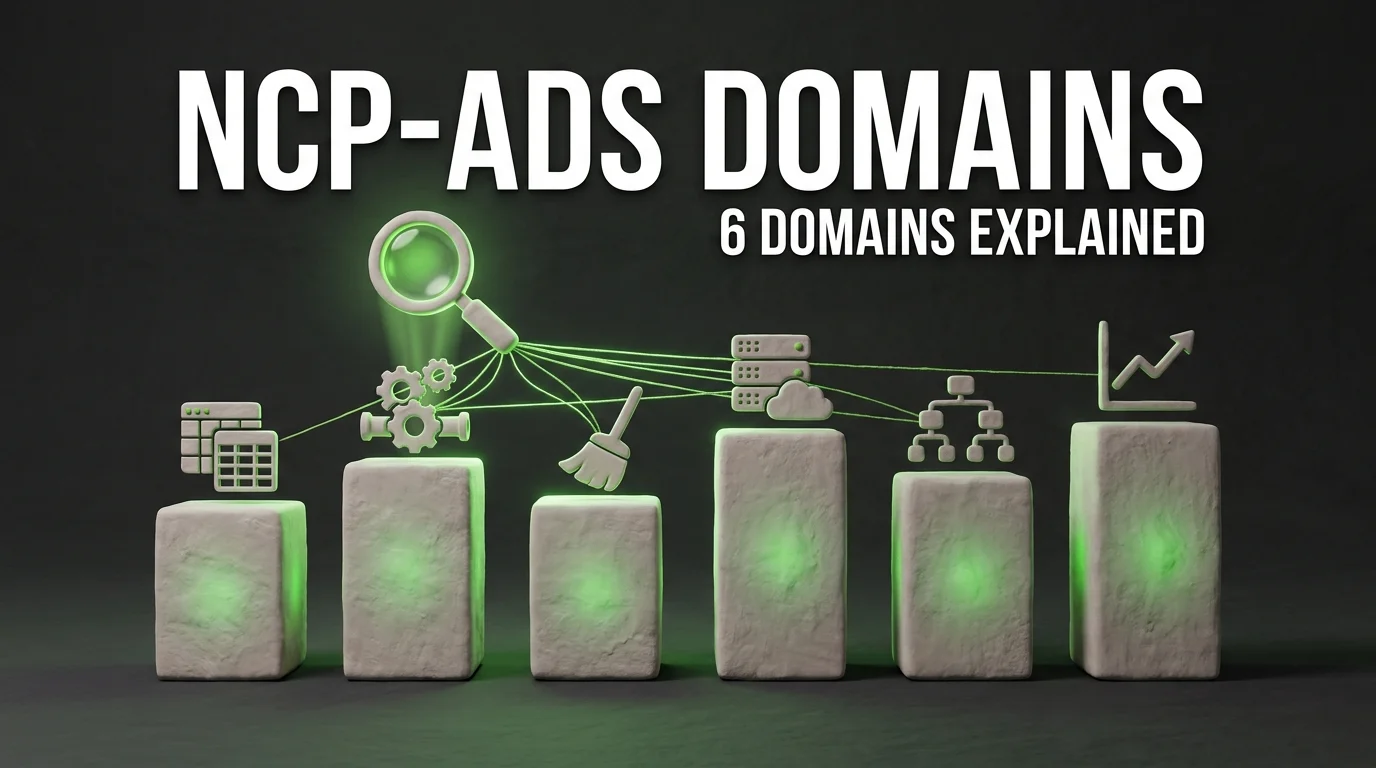
The NCP-ADS blueprint is unusually flat: six domains ranging from 14% to 19%, no single one dominating. That flatness is the plan you should study by, because a weak domain here costs you a full sixth of the exam and there is no heavyweight domain whose points cover for it. This article walks all six topic by topic at the depth the exam expects.
New to the certification? Start with the complete NCP-ADS guide. Ready to schedule the work? The 6-week plan sequences everything below.
Find out where you stand first
Take the free NCP-ADS sample questions cold (no signup, real exam style), then read on with your gaps in mind. When you are ready for full rehearsal, Preporato's NCP-ADS practice tests include 7 full-length exams (420 questions in total, domain-proportional, every answer explained) for a one-time $19.99 with lifetime access.
How to read the weights
At 60-70 questions, each percentage point is roughly two-thirds of a question. The two 19% domains (Data Manipulation, MLOps) contribute around 13 questions each; the 14% Data Analysis domain around 9. Study in weight order, but hold every domain to a passing bar, because the flat distribution means no domain can be skipped.
Domain 1: Data Manipulation & Software Literacy (19%)
The largest domain, and the heart of RAPIDS: getting data onto the GPU and transforming it fast.
ETL with cuDF. cuDF is the GPU DataFrame library, a near drop-in for pandas (import cudf as pd works for a surprising amount of code). The exam expects fluency with GPU-accelerated joins, groupbys, filters, and aggregations, and an understanding of why they are fast: the operations run in parallel across thousands of GPU cores instead of one CPU thread.
Library selection by dataset size. The most-tested judgment in this domain. cuDF wins on large data and loses on small, because moving data to the GPU has fixed overhead. The decision ladder:
- Small data (fits in memory, low millions of rows or fewer): pandas may be faster; the transfer is not worth it.
- Large data on one GPU (fits in VRAM): cuDF.
- Data larger than one GPU's memory: Dask-cuDF for out-of-core and multi-GPU processing.
Dask-cuDF and multi-GPU scaling. Dask partitions a DataFrame and processes the pieces in parallel, across multiple GPUs or larger-than-memory datasets on one. Know when to reach for it (data exceeds a single GPU) and its cost (partitioning and coordination overhead that does not pay off on small data).
Caching and distributed processing. Persisting intermediate results so a multi-step pipeline does not recompute, and the basics of distributing work across a cluster.
DLProf profiling. NVIDIA's deep-learning profiler for finding where time actually goes in a workflow, so optimization targets the real bottleneck rather than a guess.
Preparing for NCP-ADS? Practice with 455+ exam questions
Domain 2: MLOps (19%)
Tied for the largest, and the domain that separates "ran RAPIDS in a notebook" from "shipped a GPU model."
Memory optimization via data types. The recurring NCP-ADS theme. Choosing int32 over int64, float32 over float64, and categorical over string can halve or quarter memory use, which on a VRAM-constrained GPU is the difference between a workflow that runs and one that crashes with an out-of-memory error. The exam tests dtype selection as a first-class skill.
Memory assessment and comparison. Measuring how much memory a dataset or operation consumes, and comparing GPU versus CPU memory footprints to decide what fits where.
Benchmarking workflows. Rigorous GPU-versus-CPU comparison: warm-up runs, wall-clock timing, controlling for data transfer, and reporting speedups honestly. "Prove the GPU is faster" is a real exam task, and the naive benchmark (timing the first run, including transfer, on tiny data) gives the wrong answer.
Model deployment and monitoring. Serving GPU-accelerated models (including with Triton Inference Server), and monitoring them in production for drift and performance degradation.
CI/CD for data science. Automating testing and deployment of data science pipelines, so a model change ships reliably rather than by hand.
Domain 3: Data Preparation (17%)
Real data is messy, and preparation is where most data science time actually goes.
Cleansing with cuDF and pandas. Handling missing values, deduplication, type coercion, and outlier treatment on the GPU, with the same API you know from pandas.
Transformation and standardization. Scaling, normalizing, encoding categoricals, and reshaping data for modeling, accelerated on the GPU.
Synthetic data generation. Producing artificial data that preserves the statistical properties of the real thing, for augmentation, testing, or privacy. A distinct exam topic worth knowing.
Dataset acquisition and pipeline monitoring. Ingesting data from sources and watching the ingestion pipeline for failures and quality drift.
Data-type optimization for memory efficiency. The same dtype discipline as the MLOps domain, applied at preparation time: convert a 50-unique-value string column to a categorical and reclaim most of its memory. This topic appearing in two domains is a signal to master it.
Master These Concepts with Practice
Our NCP-ADS practice bundle includes:
- 7 full practice exams (455+ questions)
- Detailed explanations for every answer
- Domain-by-domain performance tracking
30-day money-back guarantee
Domain 4: GPU & Cloud Computing (16%)
The infrastructure and methodology layer under the workflow.
Graph analysis with cuGraph. cuGraph is the GPU-accelerated graph library (the RAPIDS answer to NetworkX). Know the common algorithms and their uses: PageRank (influence), community detection (clustering), shortest paths, and centrality, all at a scale NetworkX cannot touch.
Performance optimization. Finding and fixing GPU bottlenecks: data transfer overhead, underutilized GPUs, memory pressure, and suboptimal batching.
CRISP-DM methodology. The Cross-Industry Standard Process for Data Mining: business understanding, data understanding, data preparation, modeling, evaluation, deployment. The exam references it as the framing for end-to-end workflows, and expects you to know the phases and their order.
Docker/Conda dependency management. RAPIDS has specific CUDA and driver dependencies, and reproducibility is a real problem. Docker images and Conda environments pin the stack so a pipeline runs identically across machines. "Ensure this workflow runs the same on a teammate's GPU" is a container/environment answer.
Benchmarking GPU vs CPU. The methodology thread again, viewed from the compute side.
Domain 5: Machine Learning (15%)
Training models, accelerated.
Feature engineering on GPU. Building model inputs (aggregations, encodings, interactions) with GPU acceleration so the feature step does not become the bottleneck.
cuML algorithms. cuML is GPU-accelerated scikit-learn: the same familiar API (fit, predict) over algorithms like random forests, linear and logistic regression, k-means, DBSCAN, and nearest neighbors, running far faster on large data. GPU XGBoost is the go-to for gradient-boosted trees. Know which algorithms cuML accelerates and that the API mirrors scikit-learn.
Hyperparameter optimization. Searching parameter space efficiently, where GPU speed lets you evaluate many more configurations in the same wall-clock time.
Single and multi-GPU training. Training on one GPU, and scaling to several when the data or model demands it.
Memory optimization: batching and mixed precision. Processing data in batches to stay within VRAM, and using mixed precision (float16/float32) to cut memory and increase throughput. The memory theme, again, applied to training.
Domain 6: Data Analysis (14%)
The smallest domain, analytics at scale.
Time-series analysis. Working with temporal data (resampling, rolling windows, decomposition) on the GPU for large series.
Anomaly detection. Finding outliers and unusual patterns at scale, for fraud, monitoring, and quality.
Graph analytics with cuGraph. The analysis-side view of cuGraph: extracting insight from relationships (communities, influencers, paths) in graphs too large for CPU tools.
Exploratory data analysis at scale. Summarizing, profiling, and understanding datasets that are too big for interactive pandas, using cuDF's speed to keep EDA interactive.
Data visualization for big data. Rendering and summarizing massive datasets so they can be seen and understood, where naive plotting would choke.
One RAPIDS lab covers most of this map
A hands-on cuDF + cuML workflow on a real GPU touches data manipulation, preparation, ML, and the memory discipline that runs through every domain above.
Turning the Breakdown into a Score
Two habits convert this map into points. First, because the domains are near-equal, study in weight order but refuse to leave any domain below a passing level; the flat distribution punishes a single weak spot. Second, verify each domain with weighted practice questions: Preporato's NCP-ADS practice exams mirror this six-domain split across 7 full-length tests and 420 explained questions, with per-domain score tracking that shows which section still owes you points.
For the schedule, continue with the 6-week study plan, and keep the cheat sheet open for review passes.
Sources:
Last updated: July 11, 2026
Ready to Pass the NCP-ADS Exam?
Join thousands who passed with Preporato practice tests