
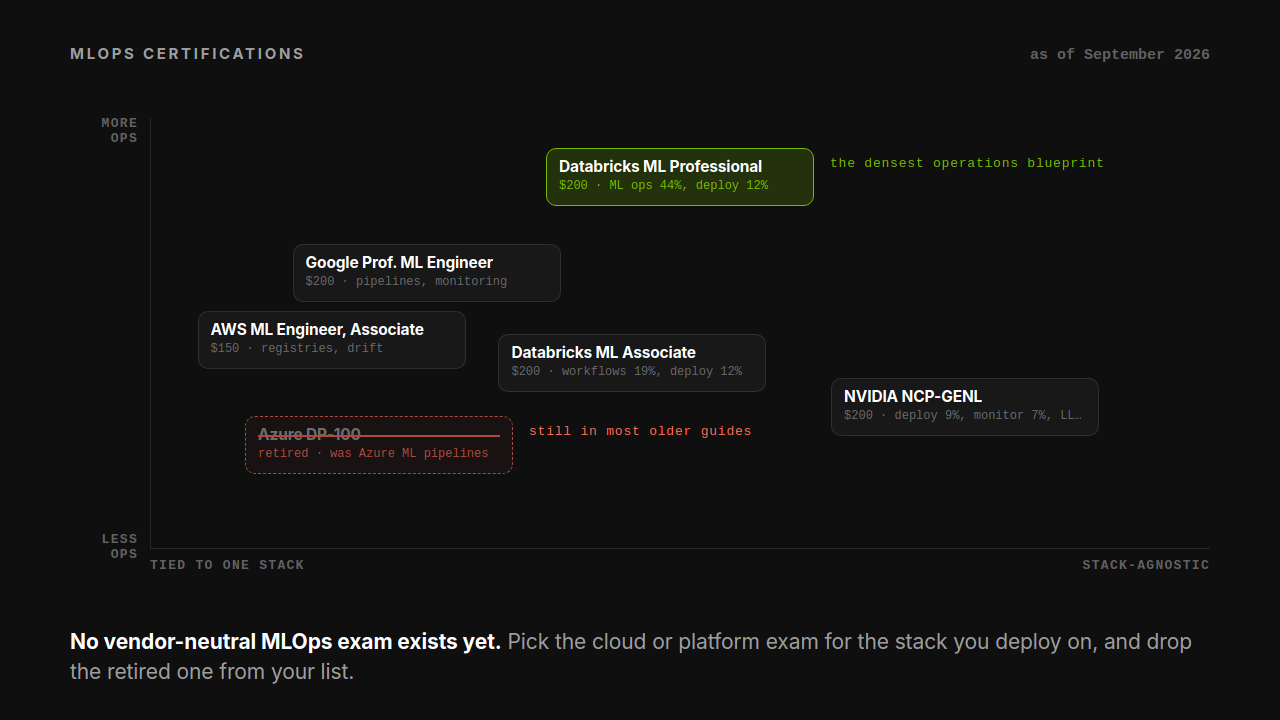
TL;DR: As of September 2026 there is no widely recognized vendor-neutral MLOps certification, so "MLOps certification" in practice means one of the cloud or platform exams that weights operations heavily. The Databricks Certified Machine Learning Professional is the most MLOps-dense (ML operations is 44 percent of the exam); the AWS Certified Machine Learning Engineer, Associate and the Google Cloud Professional Machine Learning Engineer test the loop on their own stacks; and NVIDIA's NCP-GENL covers deployment, monitoring, and reliability for language models without a cloud attached. Microsoft's Azure Data Scientist Associate (DP-100), a common answer in older guides, is retired. Pick by the stack you deploy on, and build the loop before you book.
An engineer who has shipped two models to production and kept them healthy for a year looks for a credential that says so. She finds that the phrase "MLOps certification" returns course certificates, cloud exams with MLOps somewhere in the blueprint, and one retired Microsoft exam that half the guides still recommend. The credential she wants does not quite exist, and the credentials that do exist are useful only if she reads what each one weights.
This guide does that reading. It covers the exams whose blueprints include the MLOps loop (tracking, pipelines, registries, deployment, monitoring, retraining), with the costs and formats as published on vendor pages in September 2026, the share of each exam that is actually operations, and a decision by stack.
Start here
A certification confirms a skill you can demonstrate. If you have not built the loop yet, the MLOps course guide lists the five artifacts to ship first. For the wider set of AI engineering exams, including foundational and agent certifications, read AI engineer certifications.
What "MLOps certification" means in 2026
MLOps is the loop that takes a model from experiment to monitored production system: experiment tracking, versioned pipelines, a model registry with promotion rules, deployment with rollback, monitoring for drift, and retraining on a trigger. No vendor-neutral body certifies that loop the way a cloud vendor certifies its own services, and the course certificates that use the term are coursework rather than proctored exams.
What exists instead is a set of cloud and platform exams that include the loop in their blueprints at different weights. The useful question is how much of each exam is operations, and the vendor pages answer it.
MLOps-relevant certifications, as of September 2026
| Credential | Cost | Format | Valid | MLOps in the blueprint |
|---|---|---|---|---|
| Databricks Certified ML Professional | $200 | 59 scored questions, 120 min | 2 years | ML operations 44%, deployment 12% |
| Databricks Certified ML Associate | $200 | 48 scored questions, 90 min | 2 years | ML workflows 19%, deployment 12% |
| AWS Certified ML Engineer, Associate (MLA-C01 to C02) | $150 (C02 beta $75) | 65 questions, 130 min (C02: 85, 170 min) | 3 years | Deployment, registries, drift detection across domains |
| Google Cloud Professional ML Engineer | $200 | 50-60 questions, 2 hours | 2 years | Pipelines, monitoring, and MLOps automation on Google Cloud |
| NVIDIA NCP-GENL | $200 | 60-70 questions, 120 min | 2 years | Deployment 9%, production monitoring and reliability 7%, optimization 17% |
| Microsoft Azure Data Scientist Associate (DP-100) | Retired | Retired | Retired | Was pipelines, training, deployment, monitoring on Azure ML |
Databricks Certified Machine Learning Professional
The most operations-heavy exam on the list. Fifty-nine scored multiple-choice questions in 120 minutes, $200, valid two years, with one or more years of hands-on experience recommended. The blueprint is model development (44 percent), ML operations (44 percent), and model deployment (12 percent). The operations domain names the specific practices: testing strategies, environment management with Declarative Automation Bundles, automated retraining workflows, and monitoring with Lakehouse Monitoring for drift detection, alongside deployment strategies, custom model serving, and rollout management. If your team is on Databricks, this is the credential that most closely says "I can operate models," and the Associate exam below is the on-ramp.
Databricks Certified Machine Learning Associate
Forty-eight scored questions in 90 minutes, $200, valid two years, with six or more months of experience recommended. The blueprint is Databricks machine learning (38 percent), model development (31 percent), ML workflows (19 percent), and model deployment (12 percent), assessed through AutoML, Unity Catalog, and selected MLflow features. About a third of it is operations. It suits engineers who are new to Databricks and want a credential before the Professional's experience bar.
AWS Certified Machine Learning Engineer, Associate
The current MLA-C01 exam is 65 questions in 130 minutes, $150, valid three years, scored on a 100 to 1,000 scale with 720 to pass. Its blueprint spans data preparation and transformation pipelines, model training and evaluation in SageMaker, deployment strategies, and MLOps practices including model registries and drift detection. Two dates matter if you are booking: registration for the updated MLA-C02 opened September 1, 2026, in beta at $75 with 85 questions in 170 minutes and English only, and the last day to take MLA-C01 in English is September 28, 2026. AWS recommends at least a year with SageMaker AI and Amazon Bedrock for the updated exam. Beta results take longer, so the trade is money against time.
Google Cloud Professional Machine Learning Engineer
Fifty to sixty multiple-choice and multiple-select questions in two hours, $200 plus tax, English and Japanese, valid two years under Google's professional certification terms, with three or more years of industry experience recommended including a year on Google Cloud. The exam covers the ML lifecycle on Google Cloud including pipeline automation and orchestration and model monitoring, and it was updated in 2026 to reflect the transition from Vertex AI to the Gemini Enterprise Agent Platform, so older study material will use product names the exam no longer does.
NVIDIA Certified Professional: Generative AI LLMs
Sixty to seventy questions in 120 minutes, remotely proctored, $200, valid two years, with two to three years of practical LLM experience recommended. The operations share is smaller than the Databricks Professional and it is the only exam here that tests operating language models specifically: model deployment (9 percent), production monitoring and reliability (7 percent), and model optimization (17 percent) and GPU acceleration (14 percent), which is where LLM serving economics live. For an engineer whose production models are LLMs, that combination is closer to the job than a cloud exam's classical pipeline domain. Practice tests are on the NCP-GENL page. NVIDIA also offers an AI Operations professional certification that covers infrastructure operations for AI clusters rather than the model lifecycle, which is a different job.
The one to stop recommending
The Microsoft Certified: Azure Data Scientist Associate, exam DP-100, appears in most older MLOps certification lists because its blueprint covered pipelines, training, deployment, and monitoring on Azure Machine Learning with MLflow. Microsoft's certification page now carries a retirement notice for the certification and its renewal assessment. Microsoft's current AI credential is the Azure AI Apps and Agents Developer Associate (exam AI-103), which is an application and agent exam rather than an operations one; the AI engineer certification guide covers it.
Build the loop the exams describe
Track experiments from a single run to a registered model with stage transitions, then build, test, ship, and roll back a versioned GPU container. Two of the five MLOps artifacts, on a real GPU, before you pay an exam fee.
Which one to take, by stack
The decision by stack
| You deploy on | Take | Because |
|---|---|---|
| Databricks | ML Associate, then ML Professional | The Professional is 44% operations, the densest MLOps blueprint available |
| AWS | ML Engineer, Associate (C02 beta if you can wait) | Registries, drift detection, and SageMaker pipelines are in scope; three-year validity |
| Google Cloud | Professional ML Engineer, from the current exam guide | Pipelines and monitoring on Google Cloud; note the 2026 product renames |
| GPUs you run yourself, LLM workloads | NVIDIA NCP-GENL | Deployment, monitoring, optimization, and GPU acceleration for language models |
| Azure | Nothing MLOps-specific right now | DP-100 is retired; AI-103 is an application and agent exam |
| Undecided | Build the five artifacts first, certify when the stack is known | The credential does not transfer between stacks |
Preparing without wasting the fee
Build the loop first. Every exam above assumes you can already track a run, register a model, deploy it, and monitor it. Doing those on one small model, as in the six-week syllabus, makes the operations domain the easiest part of the exam rather than the hardest.
Study from the current blueprint. The domain weights quoted here are from vendor pages in September 2026; two of the exams changed this year. Read the exam guide the week you book.
Rehearse the clock. The Databricks Professional and NCP-GENL are both two-hour exams, and pacing is the common failure. Timed practice tests fix it; for the NVIDIA exams, Preporato's are full length and domain-proportional with explanations that teach the trade-off behind each answer.
Treat the credential as a floor. The interview for an MLOps or AI engineering role is a walk through a system you operated, with questions about the rollback you rehearsed and the drift alert you caught. The certification gets you into that room.
Frequently asked questions
Key takeaways
0/7 completedNext steps
If your stack is known, book the matching exam after you have shipped the loop once. If it is not, build the five artifacts from the MLOps course guide and decide with real information. The AI Engineer path covers the loop in its production serving and evaluation modules with NCP-GENL as the checkpoint after them.
Sources:
- Databricks Certified Machine Learning Professional
- Databricks Certified Machine Learning Associate
- AWS Certified Machine Learning Engineer, Associate
- Google Cloud Professional Machine Learning Engineer and Google Cloud exam terms
- NVIDIA Certified Professional: Generative AI LLMs
- Microsoft Certified: Azure Data Scientist Associate (retirement notice)